Snowflake vs Databricks vs Fabric for Clinical Genomics 2026

Direct-to-Consumer Genetic Testing Platform Architecture: A 2026 Engineering Teardown of the Seven Layers


Direct-to-Consumer Genetic Testing Platform Architecture: A 2026 Engineering Teardown of the Seven Layers

Direct-to-Consumer Genetic Testing Platform Architecture: A 2026 Engineering Teardown of the Seven Layers

HIPAA and SOC 2 compliance checklist for genetic testing CTOs. PHI masking, audit trails, AI requirements, and SOC 2 Type II from real deployments.




Build a truly HIPAA-compliant genomics platform. Learn the hidden risks teams overlook in architecture, pipelines, EHR/LIMS integration, security, and best practices.

Modernize your legacy LIMS without disrupting lab operations. A detailed guide for genomics, diagnostics, and clinical labs, including architecture, compliance, migration frameworks, and real-world implementation steps.

Learn the 12 must-have criteria for choosing a genomics software development partner, from regulatory expertise to scalable cloud architecture & LIMS integration.

Discover the true cost of building vs. buying genomics software in 2026 – a complete decision framework for LIMS, pipelines, CDSS, and precision medicine platforms.

Learn what AWS HealthOmics is, its key benefits, and how to deploy and run a Nextflow bioinformatics workflow step by step using fully managed, HIPAA-eligible AWS infrastructure.

How to choose the right infrastructure for your Nextflow workflows based on business requirements, not just technical features.

Build a cloud-native Nextflow setup on Amazon EKS that scales automatically, cuts costs with spot instances, and runs reproducible pipelines.

Discover how genomics data engineering services enable scalable, compliant clinical diagnostics. A decision-maker’s guide to production-ready genomics platforms, cost control, and long-term reliability.

Build a fully automated, cloud-native Nextflow pipeline on AWS Batch—from FASTQC to MultiQC—while AWS handles all the infrastructure.

Learn what it takes to build a production-ready precision medicine platform. A decision-focused guide to scaling genomics, clinical data, and AI with reliability, compliance, and cost control.

Learn how automating sample-to-report workflows improves turnaround time, compliance, and cost control in genomics and precision medicine platforms. A decision-maker’s guide with real benchmarks and risk analysis.

Expert guide to digital product development for labs integrating LIMS with patient-facing portals. Architecture patterns, compliance requirements, and production-grade integration strategies.

Discover how an AI-assisted Nextflow pipeline transforms MultiQC report interpretation, automatically surfacing key QC metrics, ranking issues, and cutting manual review time for high-throughput sequencing batches.

A decision-grade guide to modern genetic lab platforms in 2026 covering architecture, workflows, AI readiness, compliance, scalability, and platform economics for genomics leaders.

When genomics organizations, clinical labs, and precision medicine companies start planning a platform build, budget conversations stall at the same point.
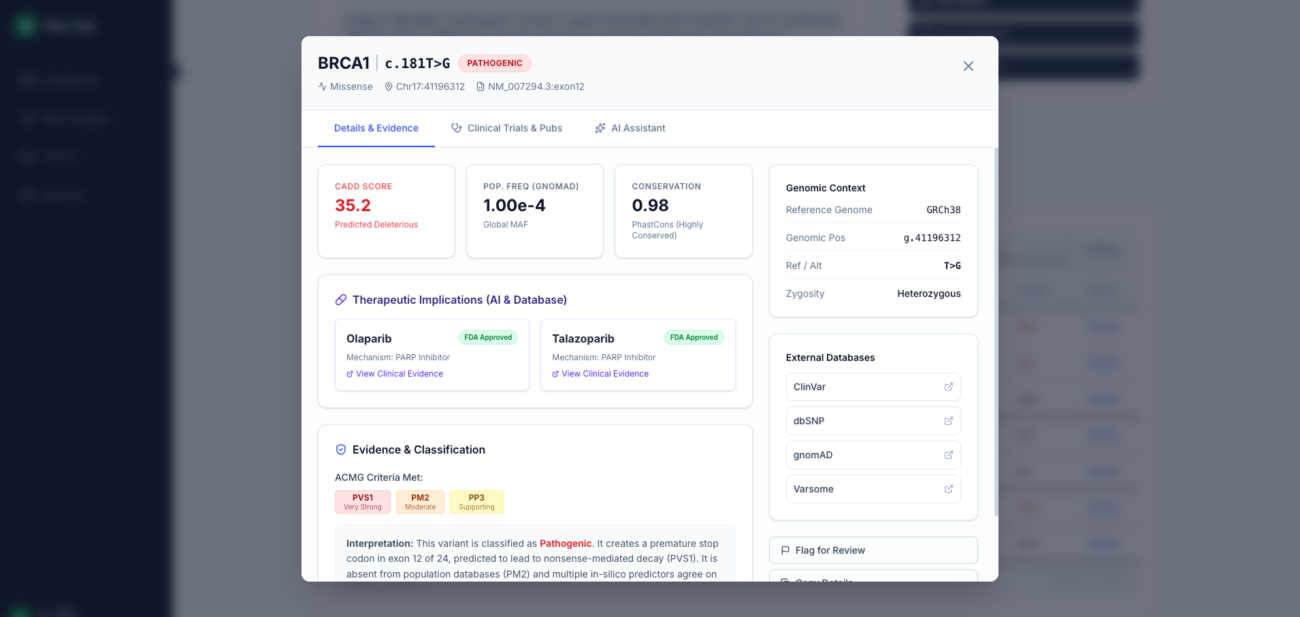
An automated tertiary analysis platform reduces variant interpretation from weeks to under an hour, covering ACMG classification, multi-database annotation, and clinical report generation from a single VCF upload.

Most genomics teams only realize their pipeline is broken when it finally breaks in production. A variant caller that worked perfectly on 200 research samples suddenly starts timing out when the dataset grows to 2,000.

Healthcare organizations reported 725 data breaches in 2023, exposing over 133 million patient records, the highest single-year total on record.

Maybe it’s a child with a rare, undiagnosed condition who has been through years of misdiagnoses and specialist referrals.

There’s a failure mode every bioinformatician has hit at least once. You’re running a WGS cohort through GATK HaplotypeCaller.

Healthcare software development costs range from $30,000 for a simple HIPAA-ready app to $1M+ for an enterprise clinical platform.

If you’re searching for a HIPAA-compliant software development company, you’re likely already deep into vendor evaluation.

In May 2024, the FDA issued a final rule that would have required virtually every clinical genomics laboratory in the United States to seek regulatory clearance for its NGS pipelines as medical devices. A federal court vacated it in March 2025.

Healthcare is the most expensive industry worldwide to experience a data breach, with an average cost of $10.93 million.

Every healthcare software platform eventually confronts the EHR integration problem. What begins as a simple requirement, “pull patient demographics from Epic,” evolves into a multi-year platform.

Here is the scenario that lands in a CTO’s inbox more often than any other right now: a vendor sends an end-of-support notice for a system the clinical operations team depends on.