


LIMS Modernization in 2026: A Complete Step-by-Step Guide for Genomics and Clinical Labs
Modernizing a legacy LIMS (Laboratory Information Management System) is no longer optional for genomics and diagnostics organizations. It has become a matter of operational survival.
A 2024 Deloitte survey found that 92% of genomics laboratories cited LIMS modernization as their top digital-transformation priority, while 63% reported failed attempts or major disruption during migration, primarily because of poor planning, compliance gaps, and insufficient architectural foresight.
The reality is straightforward:
- Legacy LIMS platforms were not designed for today’s sequencing-data volumes, integration requirements, or compliance expectations.
- Modern genomics workflows require cloud-native infrastructure, strong auditability, and reliable interoperability across laboratory, compute, and clinical systems.
Many laboratories still approach modernization as a simple IT upgrade or data-migration project rather than rebuilding the foundation of an evolving genomic enterprise.
This is where modernization projects fail and costs escalate.
This guide covers:
- Why LIMS modernization is uniquely difficult in genomics
- The architectural and compliance principles that matter most
- A practical modernization roadmap used by high-performing laboratories
- Common pitfalls and how to avoid them
- How to choose between build, buy, and hybrid strategies
Why Legacy LIMS Systems Break in Genomics
LIMS platforms were originally created to manage sample tracking, laboratory inventory, and predictable operational workflows.
Genomics changes those assumptions through:
Massive File Sizes
FASTQ, BAM, CRAM, VCF, and quality-control reports create substantial storage and transfer requirements.
Complex Pipelines
Multi-stage computational workflows require reproducibility, version control, monitoring, and failure recovery.
Interoperability Demands
Sequencers, bioinformatics tools, EHR systems, payer systems, and reporting tools must exchange data reliably.
Expanding Compliance Scope
HIPAA, CLIA, CAP, SOC 2, GDPR, and genetic-privacy requirements must all be considered.
Continuous Scientific Evolution
Assays, analysis pipelines, and interpretation logic continue to change, requiring systems that can adapt without disrupting operations.
Most legacy LIMS platforms cannot respond effectively to these demands. Their data models are rigid, integration layers are brittle, and auditability is often incomplete.
The Three Hidden Risks of LIMS Modernization
1. Operational Disruption
A laboratory cannot pause operations. If modernization disrupts sample tracking, instrument connectivity, or reporting, turnaround times, revenue, and patient outcomes may be affected.
2. Compliance Failure
If the new architecture fails a HIPAA risk assessment, SOC 2 audit, or CLIA/CAP validation, the project may become unusable in a clinical environment.
3. Vendor Lock-In or Internal Lock-In
Laboratories often purchase a commercial off-the-shelf LIMS and then customize it heavily.
They may later discover that:
- Customization costs continue to increase.
- Integration timelines expand.
- Switching platforms becomes extremely difficult.
Custom-built systems can create a different form of lock-in when the platform depends on a small internal engineering team. If key developers leave, maintenance can become difficult or impossible.
The Modern Genomics LIMS Architecture: What Good Looks Like
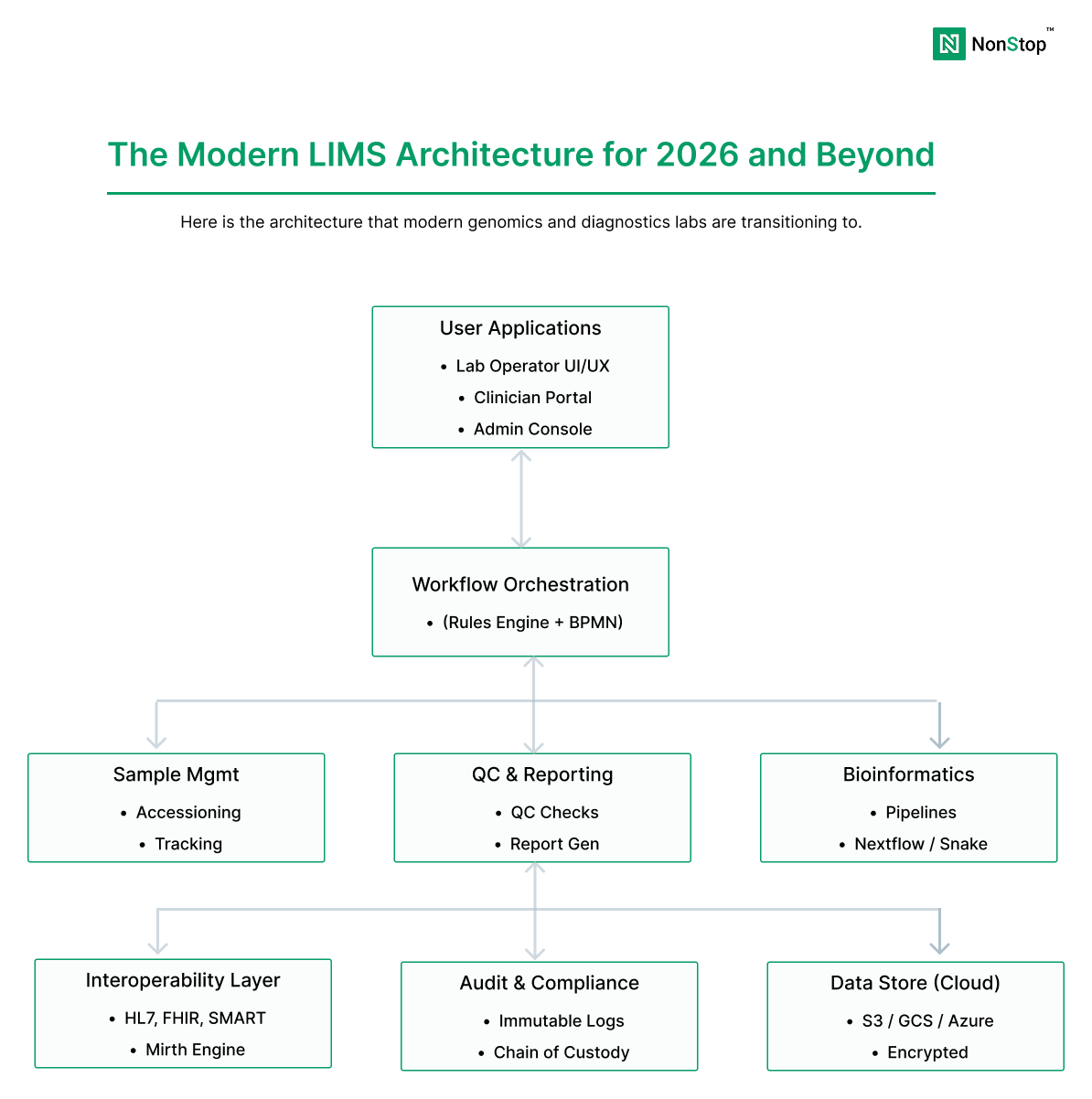
A modern genomics LIMS typically separates responsibilities into distinct layers.
Laboratory Operations Layer
Sample accessioning, quality control, chain of custody, batching, and instrument integration.
Bioinformatics Layer
Pipeline orchestration, compute, reproducibility, and analytical outputs.
Interpretation and Reporting Layer
Annotation, scoring, clinical interpretation, and report generation.
Integration Layer
EHRs, billing platforms, partner portals, CROs, and data-exchange standards such as HL7 and FHIR.
Compliance and Observability Layer
Audit logs, access controls, monitoring, and incident-response readiness.
This modular architecture allows laboratories to modernize incrementally, replace components without revalidating the entire platform, and scale compute and storage independently.
A Practical LIMS Modernization Roadmap
1. Define the Scope and Modernization Goals
Start by clarifying what is being modernized and why.
Key Scope Questions
- Are you replacing the entire LIMS or only modernizing selected modules?
- Is the main objective operational efficiency, scalability, compliance, or interoperability?
- Are you building a clinical genomics platform or a research-focused system?
- What are the target turnaround times, throughput requirements, and assay-roadmap priorities?
2. Inventory Workflows and Data Flows Before Writing Code
Many modernization failures occur because teams underestimate workflow complexity.
Document the Following
- Sample lifecycle from accessioning through quality control, batching, sequencing, analysis, and reporting
- Instrument and sequencer integrations
- Data classifications and PHI boundaries
- Pipeline orchestration and compute dependencies
- EHR and partner integrations
- Existing manual workflows
3. Classify Data and Establish PHI Boundaries
A genomics LIMS almost always contains PHI because sample identifiers, patient metadata, and genomic files may be re-identifiable.
| Data Type | Classification | Modernization Implication |
|---|---|---|
| Patient demographics | PHI | Requires strict access control and audit logging. |
| FASTQ, BAM, and CRAM | PHI and intrinsically identifiable | Must be isolated within secure processing zones. |
| VCF with clinical metadata | PHI | Requires encryption in transit and at rest, plus PHI-safe logging. |
| Aggregated statistics | Non-PHI when properly de-identified | Can support analytics without exposing protected health information. |
| Pipeline logs | Potential PHI | Requires log redaction before storage or analysis. |
| System metadata | Non-PHI | Can support operational monitoring when not connected to patient identities. |
4. Choose the Modernization Strategy: Build, Buy, or Hybrid
Most genomics organizations ultimately adopt a hybrid model: buy core utility functions and build differentiated workflows and integrations.
5. Design for Interoperability
Modern LIMS platforms must integrate with:
- Sequencers and instruments from vendors such as Illumina and Thermo Fisher
- Pipeline-orchestration systems such as Nextflow, Cromwell, and Airflow
- Clinical EHR platforms such as Epic and Cerner through HL7 and FHIR
- Billing and payer systems
- Partner portals and CRO data-exchange systems
The integration layer is often where modernization either succeeds or fails.
6. Implement Compliance by Design
Compliance is not a checklist that should be added at the end.
The platform should be designed for:
- Role-based access control and least-privilege IAM
- Centralized and immutable audit logs
- Encryption at rest and in transit
- Secure pipeline-execution zones
- PHI-safe observability with no PHI in logs
- Validation protocols for CLIA and CAP when applicable
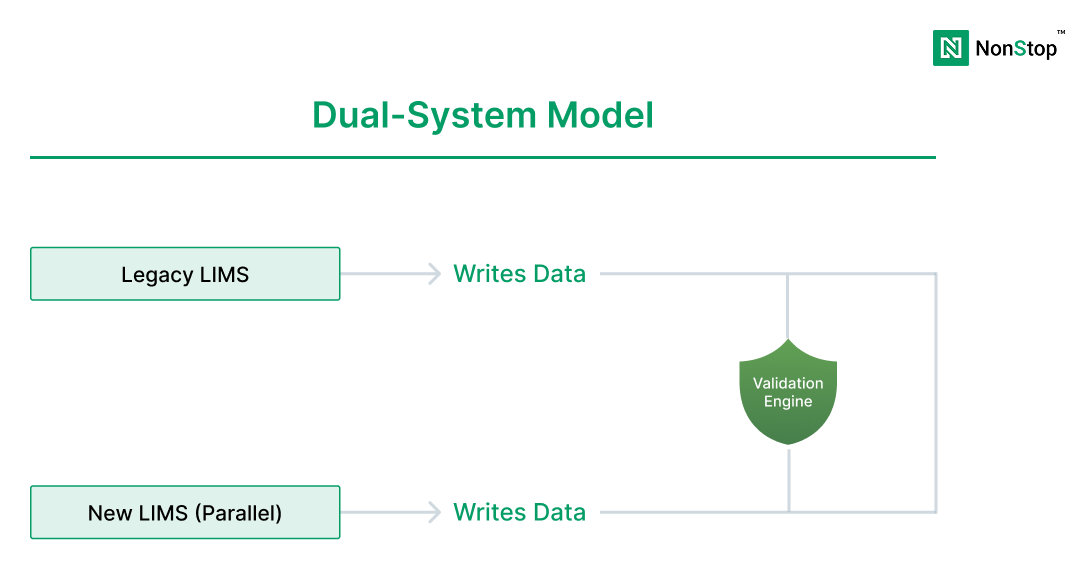
7. Execute Migration in Phases
Big-bang cutovers are one of the most common causes of laboratory disruption.
Preferred Phased Approach
- Phase 1: Run the new sample-tracking and basic workflow functions in parallel.
- Phase 2: Add pipeline orchestration and compute integration.
- Phase 3: Add reporting, EHR integration, and advanced automation.
- Phase 4: Decommission legacy systems only after stability has been validated.
Common Mistakes That Derail LIMS Modernization
Skipping Workflow Discovery
Teams underestimate how laboratory operations actually work.
Ignoring PHI Boundaries
This can lead to failed risk assessments and major re-architecture.
Insufficient Data-Migration Planning
Data-quality problems surface late in the project.
Building Monolithic Systems
Monoliths lock teams into inflexible architectures.
Underestimating Interoperability
Integration delays often dominate the overall project timeline.
No Structured Validation Plan
This can cause compliance failures and deployment delays.
Conclusion
A successful genomics LIMS modernization initiative requires more than a new interface or database migration. It demands a complete rethinking of architecture, compliance, interoperability, and operational workflows.
Laboratories that modernize successfully:
- Treat modernization as a product transformation rather than an IT upgrade.
- Design compliance and auditability into the architecture from the beginning.
- Use phased migration to avoid laboratory disruption.
- Build modular platforms that can evolve as science advances.
