

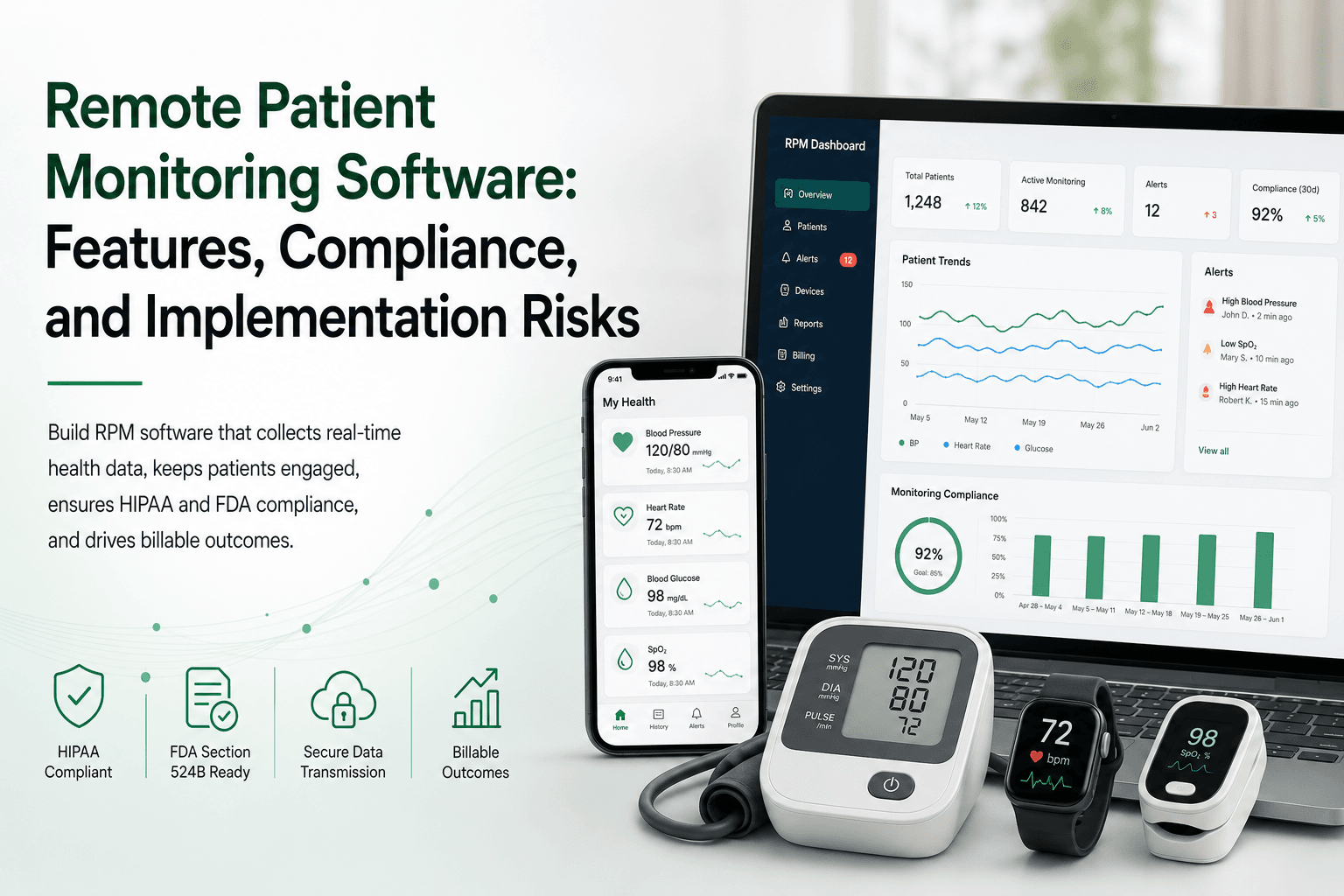
A single Medicare patient on remote patient monitoring can generate more than $1,000 in reimbursement over a year. Multiply that across a chronic-care panel, and RPM becomes one of the rare digital health products with a business model built in. That economics is why the US remote patient monitoring market is projected to nearly double, from USD 16.09 billion in 2025 to USD 29.13 billion by 2030. It is also why so many teams rush to build RPM software and then stall, not on the app, but on device data, billing rules, and compliance.
This guide is for founders, CTOs, and product leaders building or buying RPM software. It covers what the platform actually needs to do, the compliance rules you cannot get wrong, and the implementation risks that quietly kill projects, all grounded in the current 2025–2026 regulatory and reimbursement landscape.
What is remote patient monitoring software?
Remote patient monitoring (RPM) software is a platform that collects physiologic data from a patient at home through connected medical devices, transmits it securely to a care team, and turns it into clinical action and billable services. Typical inputs include blood pressure, weight, blood glucose, pulse oximetry, and heart rate. The software handles device connectivity, data ingestion, clinician review, alerting, patient engagement, and reimbursement.
RPM is not telehealth, and not the same as remote therapeutic monitoring (RTM). Telehealth is a live visit. RTM covers non-physiologic data like medication adherence or respiratory therapy and bills under a different code family. RPM specifically means automated collection and transmission of physiologic data, which matters because the billing rules depend on that distinction.
The features that separate real RPM software from a demo
Most RPM demos look the same. The gap shows up in production, under real device variety, real patient volume, and a real billing audit. Eight capabilities decide whether a platform survives that.
Device and wearable integration. The platform must ingest data from many device makers and protocols (Bluetooth, cellular, API) without custom work per device. This is the single hardest engineering problem in RPM, and the one buyers underestimate most.
Automatic data capture. Medicare requires that RPM data be collected and transmitted automatically by the device. Manually keyed readings do not qualify for reimbursement, so the ingestion pipeline is a billing requirement, not just a feature.
Clinician dashboard with smart alerting. Care teams need triage views, trends, and thresholds, but naive alerting drowns them. Alarm fatigue is a documented patient-safety problem, so alert logic has to be tunable, prioritized, and actionable rather than noisy.
Patient app and engagement. Reimbursement and outcomes both depend on the patient transmitting data on enough days. A clear, low-friction patient experience is what keeps the 16-day threshold met.
Billing and CPT automation. The platform should track monitoring days, log clinical time, and map activity to the correct codes automatically, with an exportable audit trail. This is where revenue is won or lost.
EHR interoperability. Readings and notes have to flow into Epic, Cerner, or the practice EHR over HL7 v2 and FHIR R4, or clinicians will not use the system.
Analytics and AI. Trend detection, risk stratification, and predictive alerts turn raw data into earlier intervention, the actual clinical value of RPM.
Security by design. Encryption, access control, and audit logging at every layer, built in from the start rather than added before launch.
Compliance: the rules you cannot get wrong
RPM sits at the intersection of three regulators: HHS (HIPAA), the FDA (devices), and CMS (reimbursement). Each can sink a product independently.
- Any RPM platform handles protected health information and must meet the HIPAA Security Rule.
- Technical safeguards defined in 45 CFR §164.312 require access control, audit controls, integrity controls, authentication, and transmission security (encryption in transit and at rest).
- A signed Business Associate Agreement is required with every vendor that touches PHI, including cloud and device partners.
- If the RPM offering includes or depends on a connected medical device, Section 524B of the FD&C Act applies, in force since March 29, 2023.
- Requires a software bill of materials (SBOM), a postmarket vulnerability monitoring and patching plan, and cybersecurity assurance processes in premarket submissions.
- The FDA's June 2025 final guidance made cybersecurity a condition of market authorization. Wearable wellness platforms avoiding medical claims often build to ISO 13485 as well.
CMS reimbursement rules are where the money depends on getting the codes exactly right. As of 2025, four core remote physiologic monitoring CPT codes apply.
| CPT code | What it covers | 2025 national avg. |
|---|---|---|
| 99453 | Initial device setup and patient education (once) | ~$19.73 |
| 99454 | Device supply and data transmission, each 30 days | ~$43.02 |
| 99457 | First 20 minutes of monitoring/management per month | ~$47.87 |
| 99458 | Each additional 20 minutes | ~$38.49 |
Source: 2025 CMS reimbursement rates compiled by Openloop.
Three rules trip teams up. Codes 99453 and 99454 require at least 16 days of data transmitted within a 30-day period. The data must be collected automatically by an FDA-defined medical device. And 99457/99458 require live, interactive communication with the patient, not just data review.
A separate code family (98975–98981) covers remote therapeutic monitoring. CMS revises these codes and rates annually, so the platform's billing logic has to be maintainable, not hardcoded. For EU deployments, GDPR adds explicit consent, data-residency, and processing obligations on top.
Implementation risks: where RPM builds actually fail
The features and rules above are knowable. The failures are usually in how they collide in production. Five risks account for most stalled RPM projects.
| Risk | What goes wrong | The fix |
|---|---|---|
| Device fragmentation | Point integrations built one device at a time create brittle connectors that break with every firmware update | An abstraction layer that normalizes device data on ingestion, designed before the first integration |
| Alarm fatigue | Alerts firing on every out-of-range reading train clinicians to ignore the system | Risk-stratified alerts routed into the existing clinical workflow |
| Billing non-compliance | No auditable trail of monitoring days, transmission, and time logged exposes the provider to denied claims and clawback | Billing compliance treated as an engineering requirement, not a back-office task |
| Security and breach exposure | Connected devices widen the attack surface in the most-breached sector | Security built in at every layer, from device firmware to cloud storage |
| Scaling and data volume | Architectures that work in a pilot fall over at scale under continuous monitoring across thousands of patients | Cloud-native architecture for high-concurrency ingestion from day one |
Building RPM software that ships and bills
The order matters: design the device-data and security foundation first, then the clinical workflow and alerting, then the billing automation and EHR integration. Most teams build the patient app first and discover the hard parts last.
This is the engineering NonStop.io Technologies builds for healthcare and digital-health companies, with one purpose: platforms that survive production device variety, billing audits, and scale.
IoT-enabled remote patient monitoring platforms with secure device-to-cloud data pipelines, integrating FDA-regulated medical devices and wearables into clinical workflows under HIPAA standards.
The interoperability layer engineered with HL7 v2, FHIR R4, and Mirth Connect integration with Epic, eClinicalWorks, and Athenahealth.
HIPAA-compliant mobile and backend applications built for high-concurrency real-world use, with revenue-cycle automation for accurate RPM billing and reimbursement.
Security and compliance built in, not bolted on: role-based access control, encryption, PHI masking, and continuous compliance monitoring, with 90+ clients in production across regulated industries including connected-wellness and care-delivery platforms.
Frequently Asked Questions
What is remote patient monitoring software?
What features should RPM software have?
Is RPM software required to be HIPAA compliant?
What are the RPM CPT codes and reimbursement rules?
Do RPM devices have to meet FDA cybersecurity rules?
What are the biggest risks in implementing RPM software?
Talk to NonStop.io
Book the Architecture Review
If you're building or scaling an RPM platform, the useful next step isn't a demo. It's an honest look at your device-integration strategy, your billing-compliance logic, and your security posture against HIPAA and FDA Section 524B. NonStop.io runs a 45-minute architecture review for exactly that: no pitch, just a working assessment of your device landscape, interoperability needs, and biggest compliance or scaling risk. Book the review and bring your hardest integration or billing problem.
Book the 45-Minute Review →- 27 Remote Patient Monitoring Statistics Every Practice Should Know
- US Remote Patient Monitoring (RPM) Market worth $29.13 billion by 2030
- eCFR :: 45 CFR 164.312 — Technical safeguards
- Remote Patient Monitoring CPT Codes: 99453, 99454, 99457, 99458
- Cybersecurity in Medical Devices: Quality Management System Considerations and Content of Premarket Submissions