
May 2026

Healthcare Genomics AI: Data Platforms & Federated Learning

CEO’s Message

From the Desk of the CEO

The genomics industry is shifting from bioinformatics pipelines to platform engineering in the AI era. As genomic datasets grow and AI becomes central to interpretation, the challenge is no longer just performance – it is building platforms that remain scalable, reproducible, and audit-ready.

At NonStop, we help genomics and diagnostics teams modernize their infrastructure for AI-driven workflows while supporting governance, interoperability, and compliance. This issue explores how engineering teams meet reproducibility, governance, and compliance demands for foundation-model workflows.
Saurabh Gawande,
CEO, NonStop io Technologies
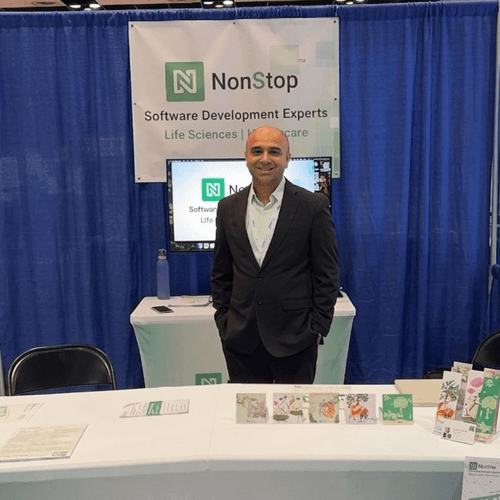
This month, I’ll be attending two major genomics and biodata events and would love to connect in person.

  • Festival of Genomics, Biodata & AI (June 3-4, 2026 | MCEC Boston) at Booth #10

  • BIO International Convention 2026 (June 22-25, 2026 | San Diego)

If you’re attending either event, I’d love to meet, exchange ideas, and discuss the real operational challenges your teams are navigating.

The future of AI in genomics isn't bigger models; it's running AI without moving petabytes of data.

The Next Frontier in Genomics Is Not Model Size- It's Where the Data Lives

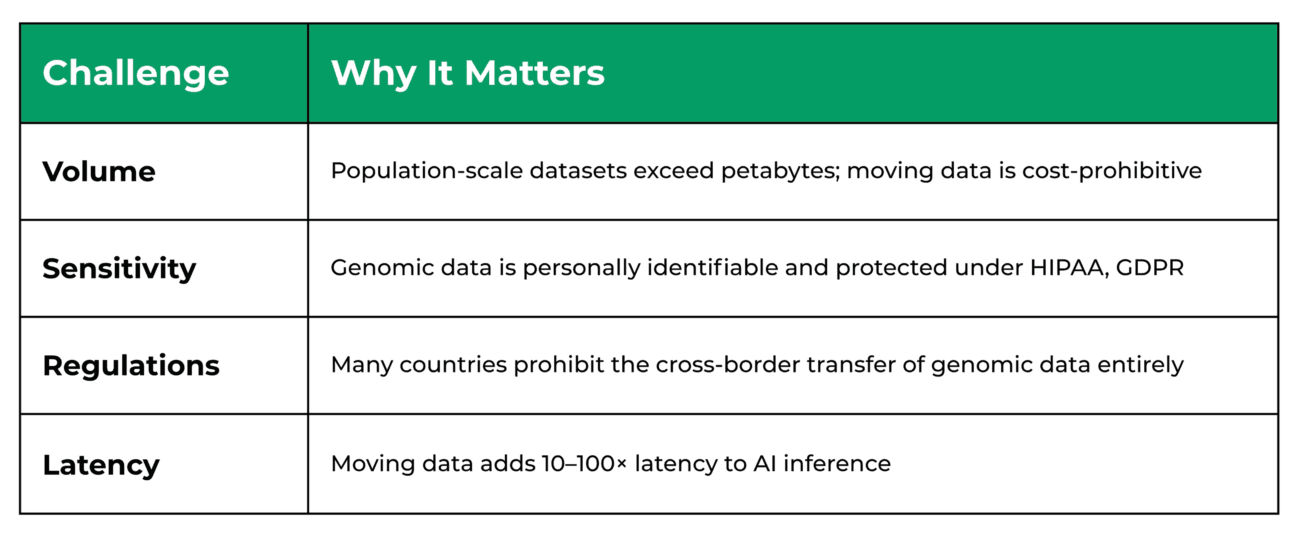
The Problem: Why You Can't Just Move Genomic Data 

The result: Organizations are stuck between needing AI insights and being unable (or unwilling) to move data.

The Shift: Bring Computation to the Data, Not Data to the Computation

The emerging solution follows one principle: keep data where it lives and bring computation to it. Here are four practical approaches to becoming production-ready in 2026:

1. Data Visitation: Algorithms Travel to Your Data

Instead of centralizing sensitive genomic data in one location, the algorithms travel securely to where the data lives.

How it works:

  • Your genomic data stays on-premises or in your regional cloud.

  • An external algorithm runs inside a secure, isolated environment (called a “secure enclave”) at your location.

  • The algorithm processes your data & returns only the results, not the raw data.

  • Your institution stays in full control; data never crosses borders.

2. Federated Learning: Train AI Models Across Multiple Institutions Without Sharing Data

Federated learning (FL) enables collaborative model training across distributed datasets without moving any raw data.

How it works:

  • Each institution trains a model locally on its own genomic data.

  • Only the model updates (gradients) are shared with a central coordinator.

  • The coordinator aggregates these updates to improve a global model.

  • Raw genomic data never leaves any institution.

3. AI Inference at the Data Source: Faster, Lower-Cost Inference

In 2026, AI infrastructure is shifting from training to continuous inference pipelines. The requirement has changed fundamentally: low-latency access to model weights and genomic context is now a first-class requirement.

How it works:

  • When an AI model processes genomic data, it stores intermediate results in a “cache.”

  • Reusing this cache avoids reprocessing the same data repeatedly.

  • Traditional data transfer: Storage → CPU → GPU (slow, multiple hops).

  • GPU Direct: Storage → GPU directly via RDMA (Remote Direct Memory Access).

4. Intelligent Data Lakes That Are AI-Ready

An AI-ready data lake isn’t just an object store. It’s the infrastructure where metadata lives in the same distributed engine as data, and catalog freshness is guaranteed at write commit time.

Clinical Lab Data Maturity Assessment

Is Your Lab's Data Infrastructure Ready to Scale?

Most labs struggle with fragmented genomic data, unreliable pipelines, and stalled AI initiatives, but don't know where to start fixing them. Take our 5-minute assessment to benchmark your data infrastructure.

What’s Coming in June

Next month, we’ll explore why genomics labs need an intelligent orchestration layer before AI agents work in production. We’ll look at how agents can coordinate across LIMS, EHR, billing, and payer systems, while still handing off exceptions to humans at the right moment.

References

  • 1. Nature Computational Science, 2026 - Scaling and quantization of large-scale foundation model enables network biology
  • 2. Stanford Law School , Why AI Cannot Forget Genomic Data