

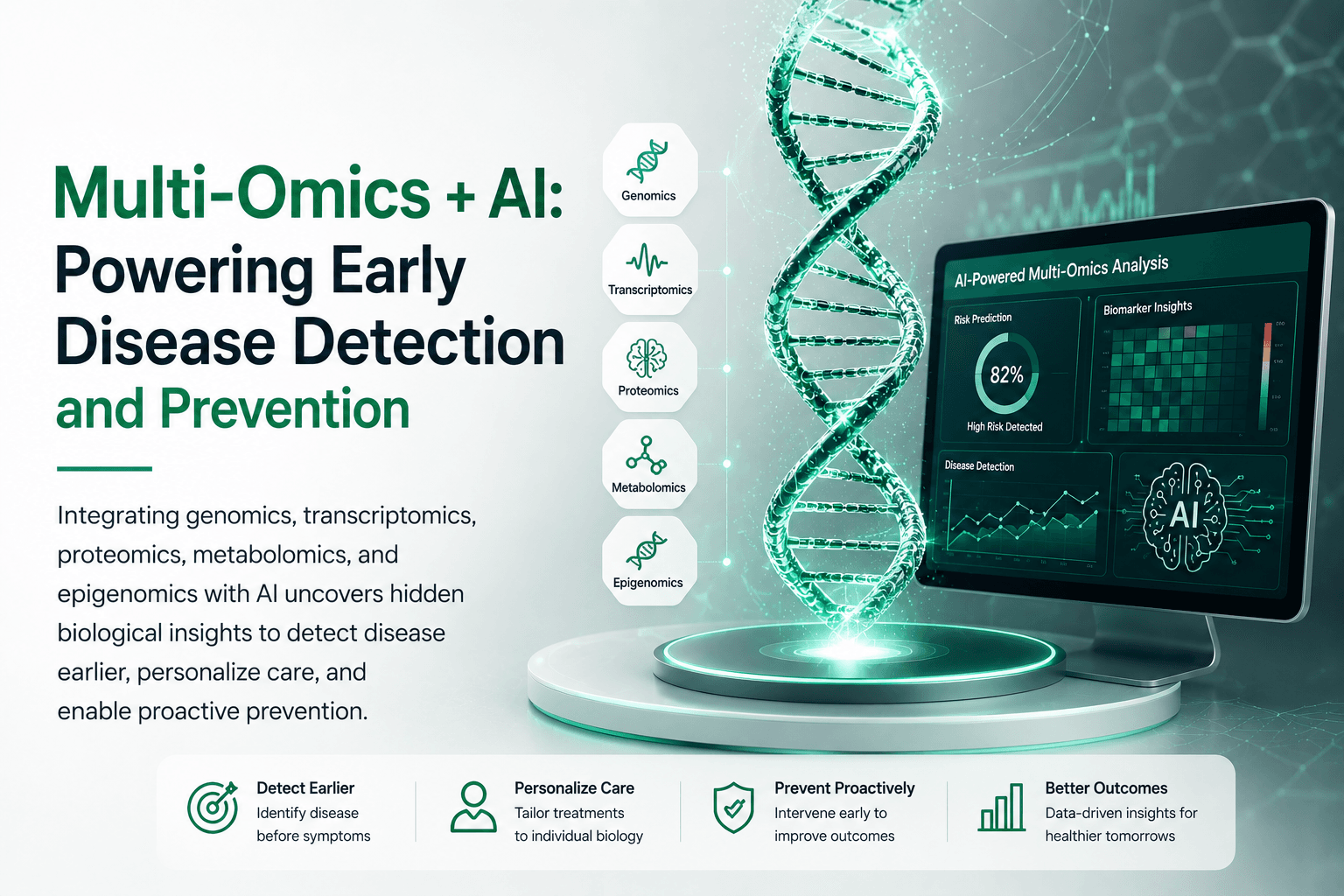
A single human genome differs from the reference at 4 to 5 million positions. One whole genome sequencing run produces over 100 gigabytes of raw data before anyone even starts interpreting it (Coruzant, 2026). A clinical team might review a few hundred variants by hand each week. That gap between what sequencing produces and what humans can actually read is exactly why AI now sits at the center of genomics.
The shift is real and measurable. Google DeepMind's AlphaMissense classified 89% of all 71 million possible missense variants as likely benign or likely pathogenic, compared to just 0.1% confirmed by human experts. The AI in genomics market shows the same trend: it was valued at USD 1.26 billion in 2025 and is projected to reach USD 18.82 billion by 2033, growing at over 40% per year.
This article covers what AI does at each stage of DNA analysis, the foundation models reshaping the field in 2025-2026, where it delivers real value in precision medicine, and the part that determines success or failure: deploying AI in a regulated lab.
What is AI in genomics?
AI in genomics is the use of machine learning and deep learning to analyze, interpret, and generate DNA and other omic data. It powers variant calling from raw sequencing reads, classifies variants against ACMG/AMP criteria, prioritizes variants of uncertain significance, predicts the functional effect of mutations, and integrates genomic data with clinical and imaging data for precision medicine. It accelerates interpretation. It does not replace clinical sign-off.
The reason AI fits genomics so well is structural. DNA is a sequence with grammar, long-range dependencies, and statistical patterns, which is exactly what modern sequence models are built to learn. The same architectures behind large language models now read genomes.
How AI works at each stage of DNA analysis
AI operates across the full sequencing pipeline, and the maturity is uneven. Knowing which stage a tool serves tells you how much to trust it.
| Pipeline stage | What AI does | Representative models | Maturity |
|---|---|---|---|
| Secondary analysis (variant calling) | Calls SNPs and indels from aligned reads | DeepVariant, Clair3 | Production-grade |
| Splice and regulatory prediction | Predicts splice-altering and non-coding effects | SpliceAI, Enformer | Strong, validated |
| Tertiary analysis (classification) | Pre-classifies variants, triages VUS | AlphaMissense, REVEL, CADD | Assistive, needs review |
| Functional and generative modeling | Predicts variant effects, designs sequences | Evo 2, Nucleotide Transformer, DNABERT-2 | Research to early clinical |
| Multi-omic and clinical | Integrates genomics with phenotype, imaging, EHR | Multimodal models | Emerging |
Variant calling is the settled case
Google's DeepVariant reframed variant calling as an image classification problem, turning pileups of aligned reads into tensors scored by a convolutional neural network (Poplin et al., Nature Biotechnology, 2018). It won the PrecisionFDA Truth Challenges for accuracy and routinely reaches SNP F1 scores above 99% on Genome in a Bottle benchmarks. Deep learning callers like DeepVariant and Clair3 now match or exceed traditional callers across sequencing technologies.
Splice and missense prediction closed a real gap
SpliceAI predicts which variants disrupt splicing, including deep-intronic variants that older tools missed. AlphaMissense, built on AlphaFold, scores missense pathogenicity using structural context and evolutionary conservation; it flags 32% of missense variants as likely pathogenic and 57% as likely benign at 90% precision on ClinVar.
Classification is assistive, not autonomous
AI aggregates evidence from gnomAD, ClinVar, REVEL, CADD, SpliceAI, and internal lab history, then suggests an ACMG/AMP tier with a confidence score. Labs running this workflow report whole-exome cases dropping from two-plus hours of analyst time to fifteen or twenty minutes. The interpreter still reviews and signs off.
The genomic foundation model shift
The biggest change since 2024 is that genomics now has its own foundation models, trained on raw DNA the way GPT models are trained on text. They learn the grammar of the genome once, then transfer to many downstream tasks.
The practical takeaway for a clinical or translational team: variant interpretation is moving from rule-based scoring toward learned, generalizable prediction, and the models keep getting better at the long-range, non-coding biology that older tools ignored.
AI in precision medicine: from variant to treatment
Precision medicine is where genomic AI reaches the patient. Three applications are real and in clinical use today.
Precision oncology
AI combines tumor DNA profiles, pathology images, and clinical records to recommend targeted therapies and surface biomarkers. Oncology is the largest therapeutic slice of the market, and companies like Tempus AI build their platforms on exactly this multimodal fusion. AI-driven somatic variant calling and tumor classification let labs scale comprehensive genomic profiling without scaling headcount.
Pharmacogenomics (PGx)
AI maps genetic variants to drug response, calls star alleles, and generates prescribing guidance aligned to CPIC and PharmGKB guidelines. Delivered into the EHR at the point of care, it turns a patient's genotype into an actionable alert before a clinician writes a prescription.
Polygenic risk and disease prediction
Models trained on biobank-scale data estimate inherited risk for common disease across thousands of variants, supporting earlier screening and prevention.
The market signal is unambiguous. AI in precision medicine is growing at roughly 20% annually, with oncology and software platforms leading adoption, and regulators keeping pace. The FDA had authorized 1,451 AI-enabled medical devices by the end of 2025 - 295 of them cleared in 2025 alone, the most in any single year.
Why most AI genomics projects stall in production
The model usually gets the attention, but on its own it changes nothing in a lab. What turns a published model into something your scientists can trust and act on is the unglamorous engineering around it - and that is where most projects stall.
Five failure points show up again and again:
No data foundation
Genomic, clinical, and phenotypic data sits in disconnected systems the model can't reach, so scientists lose hours to data wrangling instead of the interpretation only they can do. Without a governed, queryable data layer, every AI initiative stalls at the data-prep stage.
Black-box outputs
If an interpreter can't see why a model made a call, they can't sign off on it. An unexplained classification is unusable in a clinical report and indefensible in an audit.
No validation strategy
Headline accuracy on a benchmark says nothing about performance on your gene panels, your population, or your assay. Gene-dependent accuracy means validation is not optional.
Dead-end integration
A result that doesn't flow back into Epic, Cerner, or your LIMS over HL7 and FHIR R4 is a result a clinician never sees.
No drift monitoring or regulatory documentation
Models degrade in production. Without model cards, training provenance, audit logs, and a drift plan, an FDA SaMD or CE-IVD pathway is closed.
Get the foundation right, and the technology recedes into the background, leaving your scientists free to focus on the judgment and discovery that are the real value of the work.
NonStop.io's Approach to deploy AI in a clinical genomics lab
The order is the whole game. Most teams start with the model and discover the foundation isn't there.
Consolidate variant files, clinical annotations, and phenotype data onto a shared identifier in a governed genomic data lake, with role-based access, consent tracking, and immutable provenance.
Add explainability built in from the first commit (SHAP values, evidence weights, confidence scores) so clinical teams verify rather than trust on faith.
Run VUS re-analysis on a schedule so reclassification happens when evidence supports it, not when someone remembers to check.
Push results into the EHR and LIMS over FHIR R4.
Wrap everything in HIPAA-compliant, VPC-isolated, encrypted infrastructure with an audit log per classification event.
Ongoing drift monitoring ensures models continue to perform as data and evidence evolve in production.
This is the engineering that NonStop.io Technologies builds for genomics and life sciences organizations. NonStop.io engineers AI-powered variant interpretation, governed genomic data intelligence platforms, and the full ML lifecycle on proprietary omic data - from curation and labeling through training, validation, versioning, and clinical deployment with explainable outputs. NonStop.io builds the upstream bioinformatics pipelines (WES, WGS, RNA-Seq, targeted panels, liquid biopsy, PGx, and multi-omic workflows on Nextflow, WDL, and Snakemake) that feed the models, and the HL7 v2, FHIR R4, and Mirth Connect integrations that connect them to Epic, Cerner, and LIMS. The Applied AI work is compliance-first by default, mapped to HIPAA, SOC 2, and GDPR, with 90+ clients running in production. For teams building genomic platforms from scratch, the genomics and life sciences practice covers the data lake, the pipelines, the AI layer, and the clinical integration as one build.
Frequently Asked Questions
What is AI in genomics?
Does AI replace geneticists or variant interpreters?
How accurate is AI variant classification?
What are genomic foundation models?
Is AI variant interpretation HIPAA compliant?
How do you build an AI genomics platform?
Talk to NonStop.io
Book the AI Architecture Review
If you're weighing whether AI belongs in your interpretation workflow, the useful next step isn't a demo. It's an honest look at your data foundation, your integration points, and what would have to be true for clinical teams to trust an AI-assisted call. NonStop.io runs a 45-minute AI Architecture Review built for exactly that: no pitch, just a working assessment of your variant volume, current tooling, and biggest throughput bottleneck. Book the review and bring your hardest interpretation problem.
Book the 45-Minute Review →