

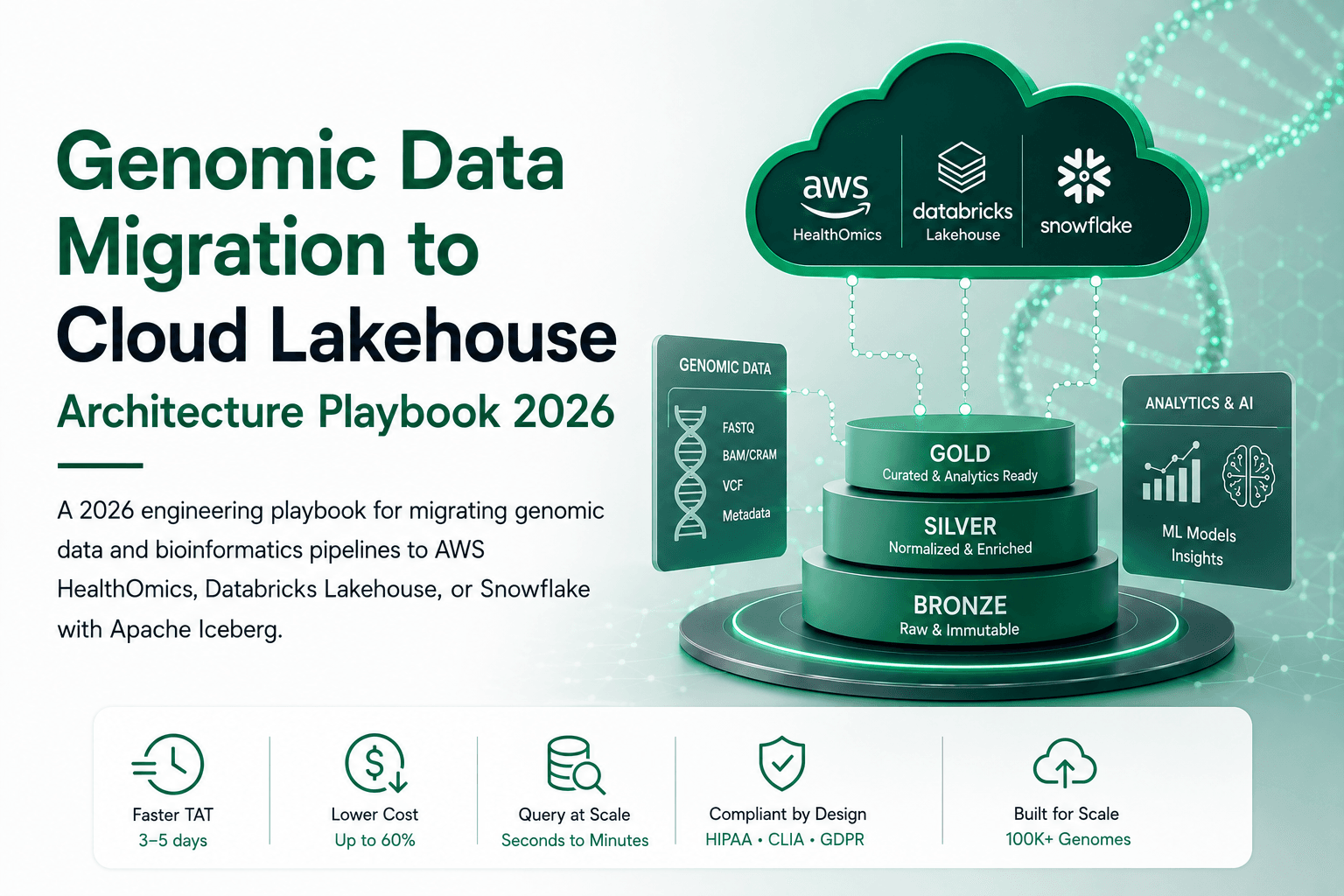
If you are running NGS pipelines on a Slurm cluster and a LIMS bought in 2014, you already know the math is broken. A single whole genome sequence generates 100–200 GB of raw data at typical 30× coverage (Illumina/NGS best practices and PRECISE Singapore genomic pipeline case study). Multiply that by population-scale cohorts of 100,000+ individuals—the standard a serious clinical genomics or biopharma program is now expected to reach—and traditional bioinformatics pipelines built around flat files and HPC batch jobs begin to crack (Temus, PRECISE 100,000+ genomes and Databricks Glow for large-scale genomic analysis).
The question in 2026 is not whether to migrate. It is about migrating without burning 2 years and 3 FTEs on a project that ends in a "data swamp" (AWS HealthOmics features and What is AWS HealthOmics?).
This playbook is for VPs of Bioinformatics, CTOs, and CIOs who have already concluded that the HPC + legacy LIMS model is not the future and need an engineering sequence that actually delivers business outcomes—faster TAT, lower cost per sample, and a foundation for AI workloads to run on (AWS HealthOmics overview and Databricks Glow and genomics lakehouse).
Why on-premises HPC and legacy LIMS are a strategic risk for genomics programs in 2026
Three forces converged over the last 18 months, turning "we can keep running this for another year" into a board-level liability.
Compute economics flipped. AWS EC2 F2 instances delivered 60% faster runtimes and 70% lower cost than F1 for DRAGEN-based WGS workflows in joint testing with AstraZeneca and Illumina. Your on-prem cluster cannot match that without a hardware refresh, which you do not want to fund.
Data formats outgrew the architecture. VCF was designed for manual inspection, not distributed analytics. Most biologically meaningful attributes, gene symbols, functional consequences, allele frequencies, are buried inside semi-structured INFO columns that need heavy string parsing to query. Legacy LIMS schemas were not built to hold them.
The lakehouse stopped being optional. Apache Iceberg v3 entered Public Preview on Databricks in October 2025, unifying Iceberg and Delta Lake at the data layer and making cross-engine reads possible without rewriting data. AWS HealthOmics added native S3 Tables Iceberg integration. Your legacy variant store cannot interoperate with any of it.
The cost of staying is no longer just slow TAT. It is the inability to run AI on your own data, the inability to participate in federated genomics consortia, and the inability to recruit bioinformaticians who refuse to write Bash glue code in 2026.
Five business outcomes that justify genomic data migration to a cloud lakehouse
Before architecture, get clear on the business outcomes the CFO will use to measure you. Every migration NonStop engineers targets these five.
| Outcome | Typical baseline (HPC + legacy LIMS) | Lakehouse target |
|---|---|---|
| TAT for clinical WGS | 14–21 days | 3–5 days |
| Cost per sample (WGS, end-to-end) | $180–$320 | $55–$110 |
| Time-to-cohort-query | Days to weeks | Seconds to minutes |
| AI/ML readiness | None — flat files, no feature store | Production-ready — single table serves Spark, SQL, ML |
| Compliance audit cycle | 4–8 weeks of evidence assembly | Continuous, log-driven, audit-ready by default |
Cost per sample ranges are modelled for 30× clinical WGS using public pricing from reference genomics labs, published cloud compute and storage benchmarks, and NonStop's experience in client migrations. These numbers are directional, not list prices, and will vary by lab economics, vendor contracts, and failure rates.
If your migration plan does not commit to numbers in the right-hand column, the migration is not worth running.
The seven-stage engineering sequence for genomic data migration to AWS HealthOmics, Databricks, or Snowflake
Migrations that succeed share a sequence. The order matters. Skip a stage, and the next one absorbs the cost.
Inventory and decision architecture. Catalogue every data source: sequencer outputs (FASTQ, BAM, CRAM, VCF), LIMS schemas, sample metadata stores, instrument middleware, secondary analysis outputs, tertiary annotation databases, and any clinical layer connected to an EHR. Score each by volume, access frequency, regulatory sensitivity (PHI vs. de-identified), and whether it is the source of truth or a derived copy.
Output: a one-page architectural decision record naming what migrates, what gets retired, what gets rebuilt, and what stays on-prem for now.
Cloud and lakehouse selection. Three architectural patterns depending on context:
- AWS HealthOmics + S3 Tables (Iceberg) + Glue Data Catalog. The default for clinical genomics labs. HealthOmics handles omics-aware sequence storage with automatic intelligent tiering, supports WDL/Nextflow/CWL natively, and is HIPAA-eligible.
- Databricks Lakehouse + Glow + Unity Catalog (on AWS, Azure, or GCP). The default for biopharma R&D and population genomics. Glow provides Spark-native VCF parsing, and Unity Catalog provides row lineage, deletion vectors, and fine-grained access control.
- Snowflake + Iceberg external tables + container services for HPC tasks. Strong fit when downstream analytics is already Snowflake-native, and the bioinformatics team wants to keep VCF/BAM in S3 while exposing variant tables for SQL.
The wrong choice here costs eighteen months. The right one depends on workload mix, existing investments, and where your AI roadmap lives.
Bronze/Silver/Gold data modelling. Genomic data does not migrate as one layer. It migrates in three.
Raw immutable VCF, BAM, FASTQ landed in Iceberg or Delta tables. The source-of-truth audit layer.
Normalised, multi-allelic-split, reference-aligned variants with sample-level genotype records exploded into queryable rows.
Annotation-enriched, cohort-aggregated, clinically interpreted tables ready for variant prioritisation, polygenic scoring, and AI/ML feature engineering.
This is what makes the difference between "we copied our data to S3" and "we have a data platform."
Pipeline modernisation. Rebuild secondary analysis pipelines on Nextflow or WDL, orchestrated through AWS HealthOmics, AWS Batch on Fargate, or Databricks Workflows. Containerise every step. Pin the reference genome and tool versions for each pipeline run to ensure reproducibility. Replace bespoke Bash with declarative workflow code that survives the engineer who wrote it.
For clinical labs, this is also the stage where DRAGEN, Sentieon, or Parabricks decisions are made. Accelerated variant calling has become table stakes for sub-5-day TAT.
LIMS modernisation or replacement. Two paths, and neither is rip-and-replace next quarter.
- Modernise the existing LIMS. Add a CDC pipeline (Debezium or native Iceberg incremental ingest) that streams LIMS events into the lakehouse, decoupling analytics from the LIMS without forcing a replacement.
- Rebuild as cloud-native microservices. When the LIMS is a 12-year-old monolith with no API, the rebuild is faster than the modernisation. Sample lifecycle, accessioning, instrument integration, and clinical reporting become independently deployable services that publish events to the lakehouse natively.
Most US labs end up in a hybrid: modernise for 12 months, then rebuild the highest-friction modules.
Compliance, governance, and PHI handling (continuous). Compliance is not a stage you do at the end. It is a stage you do continuously, starting from week one.
- HIPAA-aligned VPC architecture with KMS-encrypted storage, customer-managed keys, IAM least-privilege, and complete CloudTrail/Unity Catalog audit logs from day one.
- PHI de-identification pipeline producing research-tier datasets alongside clinical-tier datasets, with provable separation enforced at the catalog layer.
- CLIA + FDA + 21 CFR Part 11 traceability wired into pipeline metadata: every variant call is reproducible to the exact pipeline version, reference genome, and tool versions that produced it.
- GDPR data residency controls for European cohorts, enforced as policy at the storage and query layer.
Cutover, parallel run, and decommissioning. Run on-prem and lakehouse in parallel for at least one full sample cycle, typically 60–90 days. Reconcile every clinical report. Validate against NIST GIAB. Only when reconciliation shows zero clinically significant differences across a statistically meaningful sample set do you decommission the on-prem environment.
The labs that skip this step are the ones we get called to rescue six months later.
Talk to our team for a Migration Architecture Review. We map your HPC and LIMS state, score your migration paths to AWS HealthOmics, Databricks, or Snowflake, and return a phased plan in 45 minutes.
Book the Architecture Review →Four genomic data migration mistakes that derail bioinformatics programs
After running this playbook across multiple US clinical genomics and biopharma engagements, four patterns predict failure regardless of cloud or lakehouse choice.
| Mistake | What actually happens | The right approach |
|---|---|---|
| Treating it as a lift-and-shift | Copying VCF files to S3 is not a migration. Without Silver and Gold layers modelled, you have built a more expensive HPC cluster. | Model the full Bronze/Silver/Gold data architecture before moving a single file |
| Modelling variants in a relational warehouse | Genomic data is not transactional; it is wide, sparse, and annotation-heavy. Finance-schema warehouses fail at population scale. | Iceberg or Delta with proper genomic schemas (Glow, GA4GH variant representation, or custom Spark-native models) |
| Replicating the LIMS as-is into the cloud | A 2014 LIMS schema migrated to a 2026 cloud database is still a 2014 LIMS. | Decouple the workflow logic from the schema before lifting either |
| Deferring governance until phase two | Phase two never comes. Unity Catalog, Glue Data Catalog, and Polaris-based federated catalogs retrofitted after audit are painful and expensive. | Governance in the architecture from week one, not added later |
What to demand from a bioinformatics data pipeline development partner in 2026
If you are evaluating bioinformatics data pipeline development companies for this work, three non-negotiables.
Genomic data domain knowledge, not just data engineering. Knowing Spark is not knowing how multi-allelic variants split, or why GRCh38 reference handling breaks naive normalisation. Ask the partner to walk you through their last VCF-to-Iceberg pipeline at the schema level.
Compliance built into the architecture, not bolted on. HIPAA, CLIA, FDA, and GDPR controls should be visible in the IaC, not in a slide deck.
A migration plan with named outcomes, not deliverables. Hours and resources are inputs. TAT, cost per sample, query latency, and audit cycle time are outputs. Insist on the second.
How NonStop engineers genomic data migrations for clinical genomics and biopharma teams
NonStop builds genomic data pipelines, lakehouse architectures, and modernised LIMS for US clinical genomics labs, biopharma R&D teams, and population genomics programs. Engagements typically run 4–9 months end-to-end, anchored to the seven-stage sequence above, with named outcome targets in the contract.
AWS HealthOmics, AWS Batch, S3 Tables, Glue Data Catalog · Databricks Lakehouse, Glow, Delta Lake, Unity Catalog · Snowflake with Iceberg external tables.
Nextflow, Snakemake, WDL, Cromwell · GATK4, DRAGEN, DeepVariant, Sentieon, Parabricks · Apache Iceberg v3, Apache Spark, PyIceberg.
Terraform, Kubernetes, Kafka, Debezium · FHIR R4/R5 Genomics IG for clinical interoperability.
HIPAA, CLIA, FDA 21 CFR Part 11, and GDPR controls designed into infrastructure from day one, not retrofitted at audit, across 90+ clients in production.
Talk to NonStop.io
Build Your Cloud Lakehouse Migration Plan
Tell us your sequencing volume, current LIMS, and target architecture. We will return outcome-aligned scope and timelines your CFO can defend. NonStop.io runs a 45-minute migration architecture review: no pitch, just a working assessment of your HPC and LIMS state, your migration paths to AWS HealthOmics, Databricks, or Snowflake, and a phased plan with named business outcomes.
Book the 45-Minute Review →