

Did you know that genomics labs lose a significant chunk of their potential revenue to preventable claim denials? Or that some laboratories now spend more time fighting insurance rejections than analysing patient samples? If your first-pass denial rate sits in the high twenties or above, you aren't just losing money — you're losing patients who can't afford to wait through a 60-to-180-day appeals cycle.
The technology to fix this exists today. It isn't about hiring more billers. It's about engineering smart automation into the part of your workflow where mistakes get baked in: the moment a test order is mapped to a CPT code. In this article, we'll walk through what's actually driving genomics denials, what well-engineered CPT-to-test mapping looks like in production, and how to think about a 90-day path to a measurably healthier revenue cycle.
The Problem Hidden in Your RCM Data
Let's get specific about what's actually happening in your genomics revenue cycle.
A 2025 cohort study published in JAMA Network Open by Kang and colleagues at Georgetown analysed 29,919 cancer-related NGS claims across 24,443 unique Medicare beneficiaries between 2016 and 2021, and found that 23.3% of those claims were denied, with the denial rate climbing over time despite Medicare's National Coverage Determination. The trend wasn't subtle: denial rates rose from 16.8% before the 2018 NCD to 20.3% after it, to 27.4% after the 2020 NCD amendment. Claims for panels testing 50 or more genes were about three times more likely to be denied. The median charge on a denied NGS claim was $3,800 — money the lab either writes off, fights for, or chases the patient to collect.
The picture worsens when you look at how often appeals of denials are overturned. A 2025 Health Affairs study by Lin and colleagues at UCSF analysed independent medical review (IMR) data across four states from 2019 to 2023 and found that nearly half of all appeals of health plan coverage denials were overturned at IMR, and roughly one-third of cancer genetic testing denials were specifically reversed. The clinical kicker: it's estimated that less than 1% of denials are ever appealed through this pathway in the first place.
According to the FY 2025 CMS Improper Payments Fact Sheet, the Medicare Fee-for-Service improper payment rate was 6.55%, totalling $28.83 billion for the reporting period from July 2023 through June 2024. In the 2025 HHS Medicare FFS Supplemental Improper Payment Data report, laboratory tests ranked as the Part B service type with the highest projected improper payments — over $1.3 billion — with roughly 80% attributable to insufficient documentation.
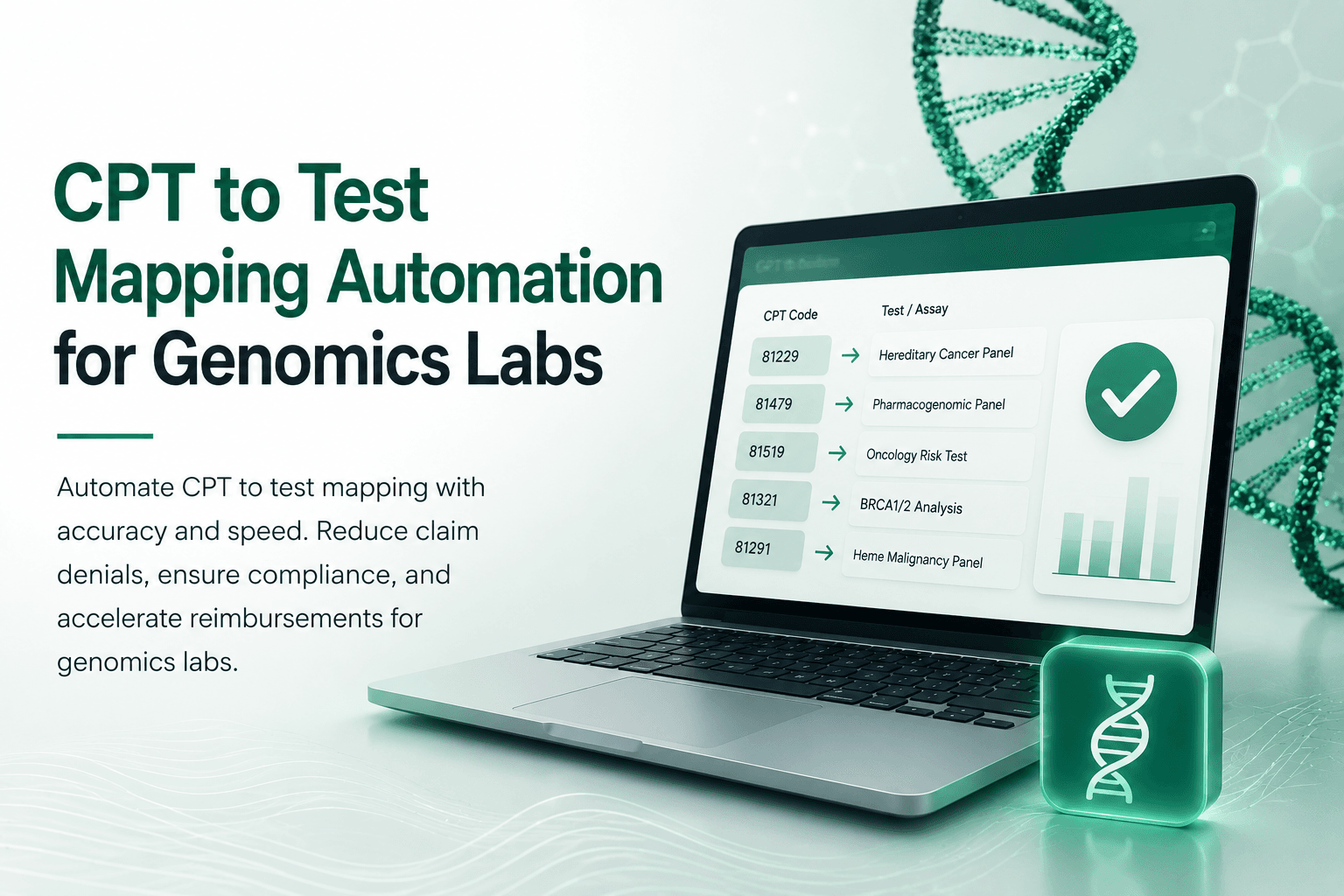
Here's what makes genomics different from traditional lab billing: the complexity multiplier. A single hereditary cancer panel might legitimately map to CPT 81432, 81433, or 81479, depending on the exact genes tested and the payer's coverage policy. Get it wrong, and you're looking at denial, appeal, and maybe payment four months later.
The takeaway: in genomics RCM, humans are manually mapping increasingly complex tests to an ever-changing landscape of CPT codes, payer policies, and coverage determinations. That manual mapping is the single biggest source of preventable denials.
What Good Looks Like in Genomics RCM
So, here is what separates labs with steady, manageable denial rates from labs stuck in the high twenties and thirties? It isn't headcount. It's where the intelligence sits in the workflow.
That shift from back-end appeal to front-end prevention is what automated CPT-to-test mapping actually delivers when it's engineered properly.
To make this concrete, NonStop recently partnered with a genomics testing organisation to build an AI-enabled Payment & Payor Workflow Dashboard that integrated payor rules and coverage logic directly into the lab's daily workflows. Before the engagement, each assay had its own rules, documentation templates lived in shared folders, eligibility checks happened in silos, and finance had no real-time visibility into pre-auth status. The build integrated payor data, lab test workflows, and revenue metrics into a single system, shifting the team from reactive billing to proactive cash flow management.
The pattern matters more than the specific numbers. When CPT mapping, eligibility, and payer rules move from email threads and spreadsheets into the test order workflow itself, denials drop because they're caught before submission, not after.
The Technical Architecture of Modern CPT-to-Test Mapping
Here is what actually works in production environments.
The Three-Layer Automation Framework
Modern genomics lab automation starts with a comprehensive test catalogue that dynamically maps each orderable to its valid CPT codes. This isn't a static spreadsheet — it's a living database that updates as you add genes to panels or payers change coverage.
Key components:
- Gene-to-CPT crosswalk covering Tier 1, Tier 2, GSP, and PLA codes
- Panel composition tracking, so you can defend exactly which genes were on the panel on the date of service
- Temporal versioning, so a claim audited two years later can be reconstructed exactly as it was billed
Here's where most labs fail: assuming one CPT code works for all payers, and that policies hold steady quarter to quarter. They don't. In 2025 alone, UnitedHealthcare discontinued coverage for certain genetic testing codes and removed prior authorisation requirements for multi-panel pharmacogenetic codes effective January 1, 2025. On the state Medicaid side, Superior HealthPlan removed prior authorisation requirements for certain genetic and molecular testing procedures effective August 1, 2025, and then added prior authorisation requirements for a different set of codes effective October 1, 2025. Two policy changes from one Medicaid plan, two months apart, in opposite directions.
The solution: a rules engine containing payer-specific coding preferences, prior authorisation requirements by CPT/diagnosis combination, coverage determination databases (LCD/NCD for Medicare, commercial policies), and state-specific Medicaid variations. The engine has to be updated continuously, not quarterly.
This is where applied AI earns its place. By analysing historical claims data, a well-engineered system learns which code combinations are paid versus denied, optimal diagnosis code sequencing for each test type, and when to use unlisted codes (81479) rather than fighting for specific codes. The output isn't a black box — every recommendation needs to be explainable so your billing team can override it, and your compliance team can audit it.
Real-World Implementation: Medicare, UnitedHealth, and Commercial Payers
Let's get tactical about the three payer categories that probably cause 60% of your headaches.
1. Medicare's Molecular Diagnostic Services (MolDX) Program
Medicare's MolDX program, administered by Palmetto GBA and active across most MAC jurisdictions, has very specific requirements. Under MolDX, laboratories must obtain a DEX Z-Code — a unique five-character alphanumeric identifier assigned to a specific molecular diagnostic test — and submit it on the claim alongside the appropriate CPT/HCPCS code. Without that Z-code, MolDX treats the claim as if it were billed under an unlisted code, and claim adjudication stalls.
Specifically, for targeted NGS panels with 1 to 4 genes, for targeted NGS panels where no specific Tier 1 or Tier 2 codes exist for the genes being tested, MolDX requires laboratories to bill CPT 81479 (the unlisted molecular pathology code) with a Z-code, rather than stacking individual Tier 1 or Tier 2 codes. Get this wrong and the claim is denied automatically. Stacking individual codes where a panel-specific code doesn't exist is a common denial trigger.
A direct integration with the DEX Registry can automate Z-code assignment at order entry, and pre-submission validation against the latest MolDX policy.
2. UnitedHealth / Optum's Laboratory Benefit Manager Program
In 2022, Optum launched its Laboratory Benefit Manager (LBM) program. Under the LBM, unspecified codes such as 81479 are denied unless submitted with a DEX Z-Code identifier obtained through the MolDX program. Miss the Z-code, and it's an automatic denial — no matter how well the test is documented.
You can automate using the API integration with the LBM program's notification system, triggering automatic submission upon test order, and a pre-submission check that no claim with 81479 leaves your system without a valid Z-code attached.
3. Commercial Payer Prior Authorisation
Most major commercial payers now require prior authorisation for genomic testing above a price threshold, and their approval criteria change quarterly. Independent labs are hit hardest — the 2025 JAMA Network Open study cited above found that claims for NGS testing were nearly twice as likely to be denied when performed in independent laboratories versus hospital labs.
A real automation solution: real-time eligibility checking, automated prior auth submission via payer portals, and smart routing of edge cases that require clinical documentation review by a human.
Where NonStop Fits In
NonStop is not an RCM vendor. We don't sell you our own billing platform. We're a software engineering partner that builds and integrates the systems that sit around your RCM platform, so the platform you've already invested in — or the one you're choosing now — actually works for genomics testing rather than against it.
That distinction matters because most genomics labs don't have an "RCM problem." They have an integration and workflow problem that shows up as an RCM problem.
What NonStop builds for genomics labs
Lab and clinical workflow software that includes pre-authorisation and payer eligibility at the order entry stage.
Our test order management system for genomics handles clinician-facing order entry with configurable test menus, automated pre-authorisation and payer eligibility verification, and direct EHR integration with Epic and Cerner, preventing duplicate entries that can introduce coding errors downstream.
Integration between LIMS, sequencing instruments, clinical systems, and RCM platforms.
We have hands-on experience integrating LabWare, STARLIMS, LabVantage, and custom LIMS platforms with downstream systems, including Quadex, Salesforce-based RCM workflows, and Careviso. The integration layer is where most genomics labs leak revenue, because every manual export between a LIMS and a billing system is an opportunity for the wrong CPT code to attach to the wrong test.
AI-enabled payor and payment workflow dashboards.
The dashboard we built for the genetic testing client referenced above unified payor rules, lab test workflows, and revenue metrics in real time, providing finance and lab ops with a single source of truth.
HIPAA-compliant architecture, built in from day one.
Every platform we deliver for clinical lab environments is architected in compliance with the HIPAA Security Rule (45 CFR §164.312), including encrypted compute environments, role-based access controls, PHI access logging, and immutable audit trails. SOC 2 controls and FDA-aligned validation are part of how we work, not an afterthought.
What we don't do
- We don't claim a fixed "denial reduction percentage" for every lab. The reduction depends entirely on where your denials are coming from today, and any vendor promising you a guaranteed number before they've looked at your data is selling, not engineering.
- We don't replace your RCM platform. We make the one you have work better.
- We don't pretend that automation alone solves payer policy disputes. Some denials are genuinely about coverage criteria that no amount of clean coding will fix — those need a clinical appeals workflow, not a coding fix.
The 90-Day Path: How We Approach a Genomics RCM Engagement
Implementing genomics billing automation doesn't require a year-long project. Here's a realistic 90-day shape for a focused engagement.
Discovery and data analysis. Extract 12 months of claims and remittance data. Map the current test menu to CPT codes. Identify the top denial reasons by payer, by code, and by test type. Calculate the recoverable revenue and the realistic upper bound on improvement given the lab's payer mix.
Configuration and integration. Build the test-to-CPT mapping database. Configure payer-specific rules for the highest-volume payers first. Integrate with the LIMS and the billing platform. Stand up the pre-submission validation layer.
Validation, parallel run, and go-live. Parallel-run the new workflow against the current process for a defined sample of claims. Validate coding accuracy against actual remittance outcomes. Train the billing team. Phase the go-live by payer or test type — a full cutover on day 90 is usually a bad idea; a phased rollout catches edge cases without breaking cash flow.
The ROI Conversation Your CFO Actually Cares About
Beyond denial reduction, well-engineered CPT mapping automation tends to deliver three other things that show up on a P&L:
Compliance risk mitigation
Incorrect coding isn't just lost revenue — it's audit risk. CMS and the OIG have made high-volume molecular labs an enforcement priority, and automated coding with full audit trails materially reduces clawback exposure.
Scalability without proportional cost
Once the rules engine is in place, handling 2x or 3x test volume doesn't require proportionally scaling the billing team. Headcount growth flattens.
Faster cash conversion
Reducing days in A/R isn't just an accounting metric — it's working capital you can use for growth instead of chasing denials. Industry-standard targets place labs' days in AR under 35–40 days, with aged AR (90+ days) below 15%. Most genomics labs we encounter are well above those benchmarks before automation, and the working capital sitting in delayed receivables is often the biggest hidden cost of the manual workflow.
Common Objections (and Honest Responses)
What is the next step?
If you're a VP Bioinformatics, a lab director, or a genomics CFO reading this, the most useful next step is almost never a sales call. It's a clean look at your own data.
If you want a second pair of eyes on it, NonStop runs a 45-minute architecture review specifically for genomics labs and platform teams. We look at your current LIMS-to-billing integration, your top denial categories, and your payer mix, and we tell you honestly where automation will and won't move the needle. No deck. No proposal at the end of the call. Just a conversation between engineers and operators.
Book a Review
Book an AI Architecture Review
Because the cost of waiting on this isn't theoretical — it's the working capital sitting in your aged AR right now, and the patients waiting on tests that their insurance just denied for the third time.
Book an AI Architecture Review →- Kang SY, Odouard I, Gresenz CR. Claim Denials for Cancer-Related Next-Generation Sequencing in Medicare. JAMA Network Open. 2025;8(4):e255785. https://jamanetwork.com/journals/jamanetworkopen/fullarticle/2832986
- Lin GA, Coffman JM, Douglas MP, Phillips KA. Use Of Independent Medical Review: Almost One-Half Of Coverage Denials Overturned. Health Affairs. December 2025. https://www.healthaffairs.org/doi/10.1377/hlthaff.2025.00716
- CMS. Fiscal Year 2025 Improper Payments Fact Sheet. https://www.cms.gov/newsroom/fact-sheets/fiscal-year-2025-improper-payments-fact-sheet
- CMS. 2025 Medicare Fee-for-Service Supplemental Improper Payment Data. https://www.cms.gov/data-research/...
- Dustman R. HHS Releases Medicare Fee-for-Service Improper Payment Rates for 2025. AAPC, March 2026. https://www.aapc.com/blog/93992-hhs-releases...
- UnitedHealthcare. Changes to genetic and molecular testing coverage and prior authorization requirements (effective January 1, 2025). https://www.uhcprovider.com/...
- Superior HealthPlan. New Prior Authorization Requirement for Certain Genetic and Molecular Testing, effective October 1, 2025. https://www.superiorhealthplan.com/...
- Palmetto GBA. MolDX Frequently Asked Questions, DEX Z-Code Identifier. https://palmettogba.com/palmetto/moldxv2.nsf/DID/9A7MFG4181
- XiFin. Optum's Laboratory Benefit Manager Program: Focus on CPT 81479. https://www.xifin.com/resource/blog-post/...
- ADSC. Lab RCM: Optimizing Revenue Cycle Management for Higher Profitability (December 2025). https://www.adsc.com/blog/lab-rcm-optimizing...
- NonStop.io. Payment / Payor Data + Test Workflow Dashboard (live case study). https://nonstopio.com/payment-payor-data-test-workflow-dashboard