

In genomics labs, the real challenge is no longer getting the sequence data. That part has become fast. The harder part is turning all that raw data into a clear, signed clinical report.
A genome can be sequenced in about a day, but the full reporting process can still take weeks. Once sequencing became faster and cheaper, variant interpretation became the main bottleneck in genomic medicine, and in complex cases, manual curation can take up to several hours of expert time per patient.
That time is not wasted. It is highly skilled work done by clinical geneticists, variant scientists, and lab directors, and their judgment is what gives the test its real value. The issue is that too much of their day goes into the manual, repetitive work around reporting instead of the scientific thinking that actually matters. Clinical report automation is meant to give that time back.
This guide explains what clinical report automation is, where turnaround time really goes, what automation should and should not handle, and how labs can reduce turnaround time without compromising the science.
What is clinical report automation in genomics?
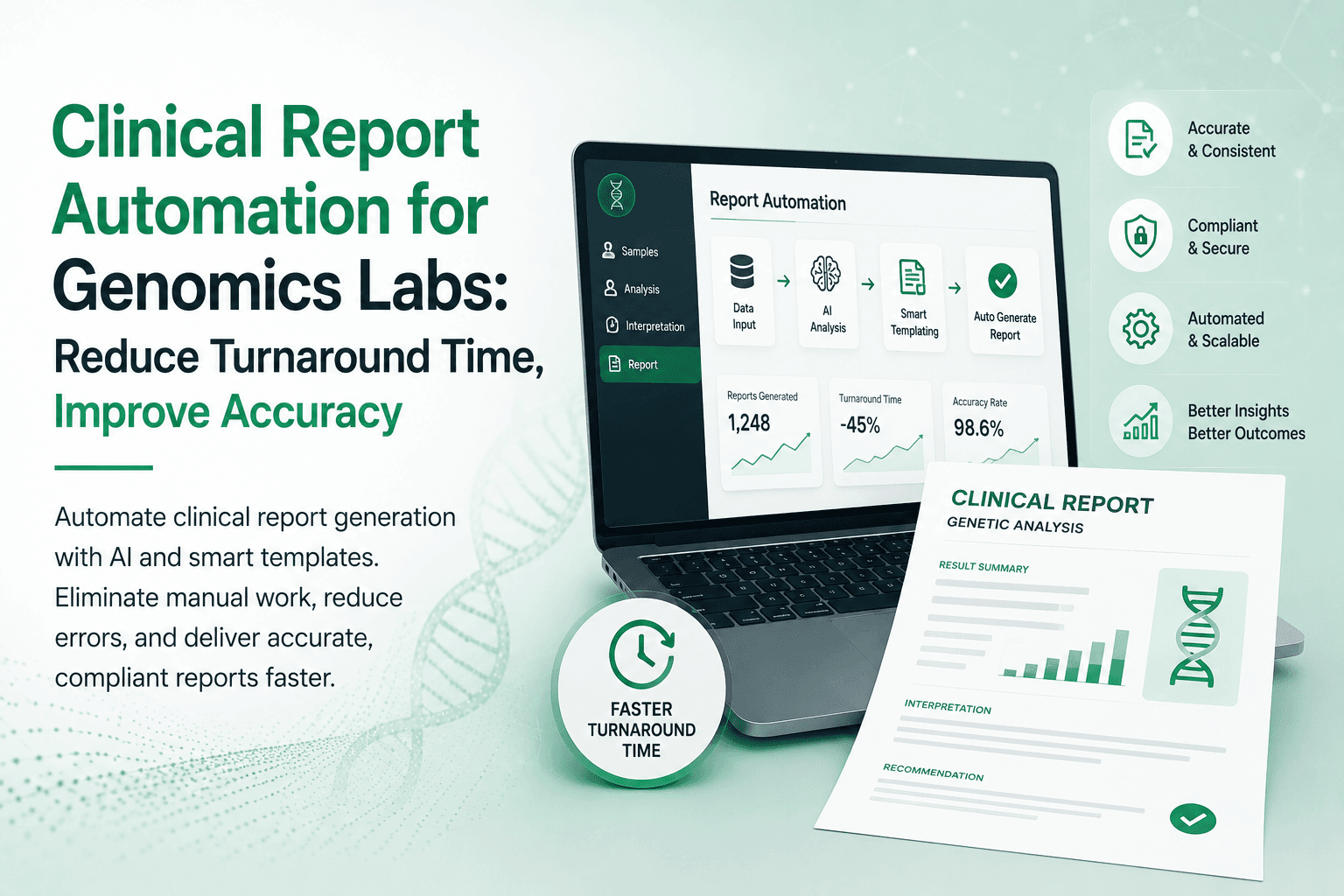
Clinical report automation is the use of software to handle the structural and repetitive steps of producing a genomic test report, so expert staff can focus on interpretation and sign-out. It covers the path from a classified variant to a delivered report: populating the report from structured data, aggregating evidence, formatting to the lab's templates, generating structured output for the EHR, and tracking versions and timestamps.
It is important to be precise about what automation does not do. It does not classify variants for you, and it does not sign out a case. The clinical decisions - which variant is causative, how it correlates with the patient's phenotype, and what the report should conclude - remain with the qualified experts. Automation removes the friction around those decisions, not the decisions themselves.
Where the turnaround time actually goes
Standard exome and genome reports are typically delivered in two to four weeks, with rapid options returning provisional results in about five to seven days. Sequencing and secondary analysis are now a small slice of that window. The rest sits in the last mile, between a variant call and a report in the ordering clinician's hands.
Three things consume it:
- Evidence gathering: an expert assembles population frequency, prior classifications, literature, and functional data from many sources for each candidate variant.
- Manual transcription and formatting: pulling classifications out of an interpretation tool and re-keying them into a report template, where every copy-paste is a chance for error.
- Handoffs between disconnected systems: a case waits in someone's inbox between the LIMS, the interpretation tool, the report, and the EHR.
None of these is scientific work, and all of them stretch TAT while pulling experts away from the analysis only they can do.
What clinical report automation should and should not touch
The line between the two is what separates safe automation from reckless automation.
- Evidence aggregation at the variant level from ClinVar, ClinGen, OMIM, gnomAD, and the lab's own interpretation history, presented in one place for the expert to weigh.
- Variant-to-report population that pulls the classified result and its evidence straight into the report template, with no manual re-entry.
- Structured delivery as a PDF plus a FHIR R4 DiagnosticReport or HL7 v2 ORU message for direct EHR ingestion.
- Version control: amendment and addendum workflows with tracked changes, approval routing, and full history.
- TAT and SLA tracking: timestamps for generation, approval, and delivery, recorded per order for accreditation.
- Variant classification decisions under the ACMG/AMP framework, where the analyst weighs the evidence and assigns the tier.
- Clinical correlation of the finding with the patient's phenotype and history.
- Final sign-out, where a qualified lab director or clinical geneticist takes responsibility for the report.
Good automation makes the expert's classification and sign-out faster and better-supported. It never substitutes for them.
How automation reduces turnaround time without cutting corners
The gains come from removing the non-scientific drag, while preserving, and often strengthening, the rigor a clinical report demands.
| Report step | Where time is lost manually | What automation does | What it preserves |
|---|---|---|---|
| Evidence gathering | Searching many databases per variant | Aggregates evidence at the variant level automatically | The expert's judgment on what the evidence means |
| Classification capture | Re-keying results into a report | Structured evidence capture in an ACMG workflow | The analyst's tier assignment and rationale |
| Report drafting | Copy-paste and manual formatting | Templated variant-to-report population | Lab-specific templates by assay and indication |
| Review and sign-out | Cases waiting between systems | Approval routing and multi-analyst review queues | Human sign-out and accountability |
| Delivery | Manual upload or fax to the EHR | FHIR R4 / HL7 v2 delivery to Epic or Cerner | Accurate patient matching and audit trail |
| Reanalysis | Forgotten until re-requested | Scheduled VUS review and reclassification triggers | Clinician notification and expert re-review |
Most delays and errors in genomic reporting happen at the handoff points between disconnected systems. Connecting them, so a completed classification flows into the report template and a signed report flows into the EHR, is where the largest, safest TAT reductions come from. That last item matters more over time: reanalysis of existing data improves diagnostic yield by roughly 7% per year, so automating the reminder to re-review VUS turns a forgotten task into recovered diagnoses.
Getting it right: what automation must protect
Speed that sacrifices defensibility is a liability in a clinical lab. Any report automation worth deploying has to protect five things.
Keep ACMG/AMP rigor intact. The 2015 ACMG/AMP five-tier framework, refined by ClinGen's Sequence Variant Interpretation Working Group into a quantitative, point-based system and by gene-specific expert panels, is the standard, and automation should structure and enforce it, not bypass it.
Preserve evidence traceability, so every classification links to the evidence behind it.
Support multi-analyst review, because a second qualified reviewer is a safeguard, not an inefficiency to remove.
Maintain a complete, immutable amendment trail for CAP and CLIA accreditation.
Avoid the black box: a system that produces a conclusion the lab cannot inspect or reproduce has no place in clinical reporting.
These are not constraints on automation. They are the reason automation can be trusted in a setting where the report changes a patient's care.
How to automate clinical reporting (where NonStop.io fits)
The order matters: structure the interpretation workflow first, connect the systems that hand work between each other, then automate report generation and delivery on top. Automation bolted onto disconnected systems just moves the bottleneck.
This is the engineering NonStop.io Technologies builds for clinical and reference labs, with the explicit goal of returning expert time to interpretation and discovery.
ACMG/AMP variant classification workflow solutions with configurable rule sets, structured evidence capture at the variant level, multi-analyst review, and a complete audit trail through sign-off, with knowledge-base integration across ClinVar, ClinGen, and OMIM so classification is evidence-backed and defensible.
Clinical report generation that populates configurable templates from classified variants with no manual re-entry, produces structured output as PDF plus FHIR R4 DiagnosticReport and HL7 v2 ORU for direct delivery into leading EHR platforms, and manages amendments, approval routing, and version history.
Runs on scheduled review with reclassification triggers and automated clinician notification, and TAT is tracked per order for SLA and accreditation reporting.
Because most delays come from handoffs between disconnected systems, the AI-assisted interpretation layer and the underlying bioinformatics and clinical platform are built to connect end to end on HIPAA-compliant infrastructure, always leaving classification and sign-out with the lab's qualified experts.
Frequently Asked Questions
What is clinical report automation in genomics?
How does report automation reduce turnaround time?
Does automation replace the clinical geneticist or lab director?
How does report automation maintain ACMG and accreditation compliance?
What is the typical turnaround time for a genomic test report?
Can automated reports integrate with Epic or Cerner?
Talk to NonStop.io
Book the Architecture Review
If your reports are the slowest step in your lab, the useful next step isn't a demo. It's an honest look at where cases actually wait, how much expert time goes to transcription instead of interpretation, and what would have to connect for reports to move faster without losing rigor. NonStop.io runs a 45-minute architecture review for exactly that: no pitch, just a working assessment of your reporting workflow, your TAT baseline, and where automation would safely help. Book the review and bring your current turnaround numbers.
Book the 45-Minute Review →