
Why Genetic Testing Denials Spike When Intake Breaks
A $3,000 hereditary cancer panel gets denied, and nobody can say exactly why for six weeks. The sequencing was right. The interpretation was right. Somewhere between intake and the claim, a form got misread, and by the time the denial letter shows up, that form is long gone.
This happens more than most labs realize, and it's about to get worse. The AMA's 2026 CPT update added 288 new codes, and the code family covering most genomic and molecular tests, Proprietary Laboratory Analyses, makes up the largest share of them at 27% (AMA, September 2025). This article is about where these denials actually start, why most billing-side fixes never reach the real problem, and what it looks like when a lab fixes the leak at intake instead.
In short: most genetic testing denials trace back to a requisition error, not a coding error, and the fix that actually works sits upstream of billing, in the software that reads and validates the order before a coder ever sees it. For lab software teams deciding where to invest first, that's the answer: not billing automation, but fixing what billing receives.
Key Takeaways
- The AMA's 2026 CPT update added 288 new codes overall, with Proprietary Laboratory Analyses (PLA) codes, the family covering most genomic and molecular assays, making up the largest single share at 27% (AMA, 2025)
- NGS panel codes such as 81445, 81450, and 81455 require an active MolDX Technical Assessment and a registered DEX Z-Code efore Medicare or several commercial payers will reimburse them; without it, the entire code family denies regardless of how accurate the rest of the claim is (Palmetto GBA MolDX Program; CMS Medicare Coverage Database, Article A55197)
- Most public denial-prevention advice targets the billing team. In practice, the requisition data reaching billing is often already wrong, which means the fix has to sit upstream of coding, not inside it
- A requisition intake process that re-keys 40 to 60 forms a day across a dozen provider layouts is a data-entry problem before it is a coding problem, and data-entry problems have a software fix
- Worth knowing upfront: fixing this doesn't mean replacing an existing billing system. The leak usually sits earlier in the workflow, which is also why it's typically a short diagnostic conversation, not a long implementation decision.
What Actually Causes Genetic Testing Claims to Get Denied?
Denials get blamed on coding teams more often than the workflow supports. The pattern that shows up across lab operations: the error is already sitting in the requisition before a coder ever opens the claim.
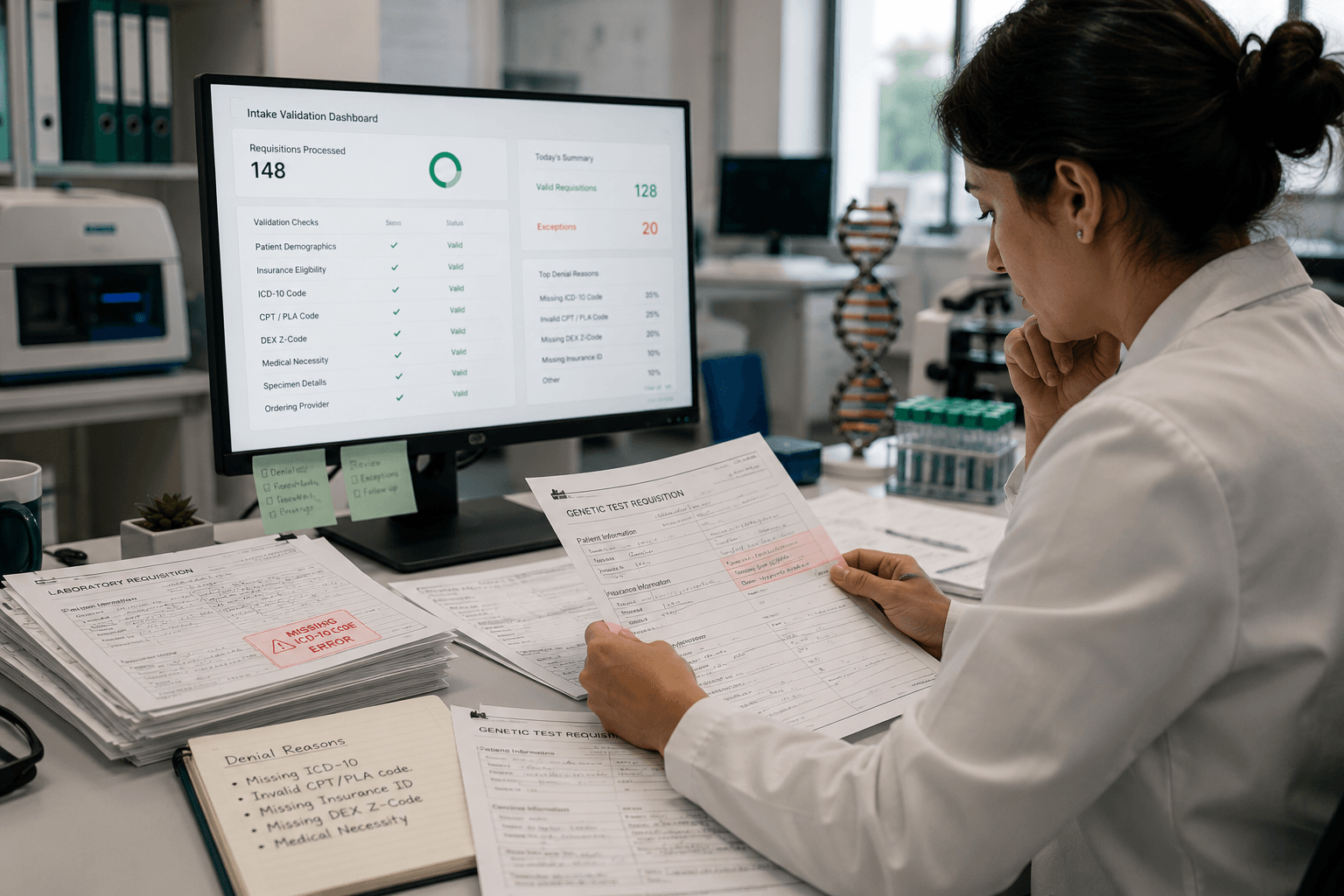
A requisition intake team re-keying dozens of forms a day across different referring-provider layouts will mistype something. A wrong ICD-10 code, a missing insurance ID, a duplicate order that slips through twice, each of those travels downstream and surfaces weeks later as a denial that gets attributed to "coding error" when the coding never had a clean input to work with. This is exactly the class of problem lab software is built to catch before it reaches a claim.
The new PLA code structure adds a second layer of risk on top of this. PLA codes are alphanumeric, tied to a specific assay version, and updated quarterly. A charge master that isn't reconciled against the current PLA list keeps billing retired codes, and retired codes are denied automatically regardless of medical necessity.
How Much Can a Single Missed Regulatory Step Actually Cost?
Molecular and NGS testing carries a specific exposure that most general RCM advice doesn't cover. Panels billed under codes 81445, 81450, or 81455 require a laboratory to register the test in the DEX Diagnostics Exchange Registry, obtain a DEX Z-Code, and pass a Technical Assessment demonstrating analytical validity, clinical validity, and clinical utility before the MolDX program will reimburse it (Palmetto GBA, DEX Z-Code Information). Standard Technical Assessment review takes three to four weeks; complex reviews can run up to 60 days.
A lab with a clean requisition and accurate coding can still be denied in bulk if that registration lapses or was never completed for a given test. This is a compliance and systems problem before it is a billing problem, and it's invisible from inside a billing queue that only sees the claim after it's already been rejected.
The mechanics of that exposure got stricter in 2025. Effective May 1, 2025, MolDX claims submitted without a valid DEX Z-Code in the required electronic claim field are denied as unprocessable, not pended for review, denied outright, regardless of how accurate the sequencing, interpretation, or coding behind them is (Noridian Healthcare Solutions, MolDX Claims Bulletin, March 2025). Run the numbers on what that means in practice.
A mid-sized lab billing 200 NGS panels a month at an average $3,000 per panel is moving $600,000 a month through codes that require an active Z-Code. If registration lapses on even one panel type for a single billing cycle, and a portion of that volume denies unprocessable, every one of those claims goes back through manual rework rather than automated resubmission.
Denial rework on claims with missing or invalid required data typically runs $25 to $35 in staff time per claim once identification, correction, and resubmission are accounted for (MedSole RCM, CO-16 Denial Code Guide, 2026), and that figure doesn't include the delay in cash flow while the claim sits in accounts receivable. A registration gap that goes unnoticed for a full billing cycle turns a compliance oversight into a five- or six-figure receivables problem, on top of the denied revenue itself.
Common Denial Codes in Genetic Testing: What Shows Up on the 835
Most of what surfaces on a genetic testing remittance advice traces back to a small set of standardized Claim Adjustment Reason Codes (CARCs), maintained by X12 and used industry-wide under HIPAA.
| CARC | Standard Description | Typical Root Cause in Genomics Billing |
|---|---|---|
| CO-16 | Claim/service lacks information or has submission/billing error(s) | Missing or mistyped requisition field: NPI, date of birth, diagnosis pointer |
| CO-197 | Precertification/authorization/notification/pre-treatment absent | Prior authorization not obtained or not submitted with the claim |
| CO-B7 | Provider was not certified/eligible to be paid for this procedure/service on this date | Missing or lapsed DEX Z-Code / MolDX Technical Assessment for the billed test |
| CO-11 | The diagnosis is inconsistent with the procedure | ICD-10 code on the requisition doesn't support medical necessity for the test ordered |
| CO-50 | These are non-covered services because this is not deemed a medical necessity | Payer policy gap or missing clinical documentation supporting the order |
CO-16 is the code that shows up most often, and it is almost always a requisition problem wearing a billing costume: the claim itself is fine, but a data element it depends on, an NPI, a date of birth, a diagnosis pointer, never made it in cleanly (MedSole RCM, 2026).
CO-B7 is the one specific to molecular and genomic testing: it fires when a lab bills a code that requires MolDX certification, a DEX Z-Code, or an active Technical Assessment, and that registration isn't current on the date of service (MDClarity, CARC B7 Reference). Both are preventable at intake. Neither is fixable after the claim has already gone out.
A denial log with a recurring CO-16 or CO-B7 pattern is usually a fast diagnosis for someone outside the day-to-day workflow. A 15-minute scoping call is enough to find out whether the leak sits at intake, in a lapsed registration, or somewhere further downstream.
Is Claim Denial a Billing Problem or a Software Problem?
Most public content on genetic testing denials is written from the billing side: coding accuracy, modifier usage, payer policy tracking. That's real and necessary work, and for labs with clean intake data, it's often the right layer to fix first.
But a billing team works with whatever data reaches it. If the requisition already has a transposed date of birth or a missing field, billing is managing a denial that was guaranteed the moment the form was misread, not preventing one. For lab software interfaces built without a validation layer at intake, that error stays invisible until the denial letter arrives, weeks later, with no clear line back to where it started. The upstream fix is software: something that reads, validates, and flags every requisition before it reaches billing at all.
That distinction is the reason NonStop built software for this exact failure point instead of a billing workflow add-on. Requisition errors and duplicate EHR orders are systems problems with a systems fix, not a staffing problem that needs more people re-keying forms carefully.
What Does Automated Intake and Order Validation Actually Look Like in Production?
NonStop's SmartReq reads every incoming requisition, including printed text, handwriting, checkboxes, and circled options, and detects the template automatically across more than 20 referring-provider layouts. Schema validation runs before a human reviews the form, so a clean extraction and a valid one aren't treated as the same thing. Low-confidence fields get flagged for confirmation instead of being silently dropped. Every extraction and edit is logged for accreditation review, and the system runs on-premise, so patient data never leaves the lab's own infrastructure.
Intergenix sits at the next stage: EHR order validation over Mirth Connect. It checks every order at intake for completeness and business-rule validity, deduplicates before validation so duplicate retries never enter the billing queue, and reports the exact field that failed and why, instead of a generic rejection. Bidirectional FHIR R4 and HL7 sync keeps order and result flow reliable in both directions.
Both are engineered for HIPAA environments, and both are self-hosted, so the lab owns the system once the engagement ends rather than renting a workflow it can't inspect.
Seeing SmartReq or Intergenix run against a real batch of this lab's own requisitions is the fastest way to know whether either fits the workflow. That's exactly what a scoping call is for.
How Fast Can a Lab See Results From This?
In NonStop client deployments, requisition processing time has dropped from a 15-to-25-minute manual read per form to under two minutes, with results varying by lab volume, payer mix, and requisition complexity. A separate NonStop client engagement, an on-premise AI intake build, moved manual review from every incoming form to exceptions only, handled more than 20 provider templates automatically, and kept all patient data on-premise throughout.
None of this replaces a lab's compliance program, its coding team, or its MolDX registrations. It changes what reaches them. A coder working from a validated, deduplicated, schema-checked order has a real shot at a clean first-pass claim. A coder working from a re-keyed form does not, no matter how good the coding is.
Frequently Asked Questions
Can software actually prevent CPT coding denials, or only catch them faster?
Software can't fix a coding error after the claim is submitted, but it can prevent the upstream data errors, wrong dates, missing fields, duplicate orders, that cause a large share of denials in the first place. Coding accuracy still depends on trained coders, current payer policy, and active MolDX registration for applicable NGS codes.
Does intake automation replace a lab's billing or RCM team?
No. It changes the quality of what reaches that team. A billing team working from validated, deduplicated orders has fewer denials to manage in the first place, and fewer denials that trace back to data it never had a chance to check.
Is on-premise deployment required for genomics intake software?
Not required, but common in CLIA and CAP environments where labs want patient data to stay inside their own infrastructure rather than a third-party cloud, particularly for requisition and order data that includes PHI.
What are the most common CARC denial codes in genetic testing billing?
CO-16 (claim lacks required information), CO-197 (missing prior authorization), and CO-B7 (provider or test not certified for the billed procedure) account for most of what shows up on genomics remittance advice. CO-16 and CO-B7 in particular are usually intake problems, a missing field or a lapsed registration, rather than coding mistakes.
How long does DEX Z-Code registration take, and what happens if it lapses?
Standard Technical Assessment review runs three to four weeks, with complex reviews taking up to 60 days. If a registration lapses or was never completed for a given test, claims billed under that code are denied outright as unprocessable rather than being flagged for review, which is why tracking registration status has to happen before claims go out, not after they come back denied.
Genetic testing volume is growing faster than most labs' intake processes were built to handle, and the 2026 CPT changes make the gap between a validated requisition and a re-keyed one more expensive than it was a year ago.
Next Step
Talk to NonStop
If a lab is losing revenue to denials it can't fully explain, an AI Architecture Review is a 45-minute, no-pitch session that maps where in the workflow-intake, coding, or claims, the leakage is actually happening.
References
- AMA CPT 2026 Update, September 2025.
- Palmetto GBA. MolDX Program, DEX Z-Code Information.
- CMS Medicare Coverage Database, Article A55197.
- Noridian Healthcare Solutions. "Proper Submission of DEX Z-Code for Molecular Diagnostic Services (MolDX) Claims." March 27, 2025.
- MedSole RCM. "CO-16 Denial Code Explained: Complete Guide to Fix & Prevent." 2026.
- MDClarity. "Denial Code B7: Explanation & How to Address."
- MedSole RCM. "CO-197 Denial Code: Complete Guide to Resolution & Prevention." 2026.

Mahendra works as a Sr. Bioinformatics Engineer at NonStop. He builds genomic pipelines, agentic AI systems, and AI-powered products for genomics and life sciences. He has 10+ years of experience in bioinformatics and genomics software. He studied Biotechnology at Mumbai University.