
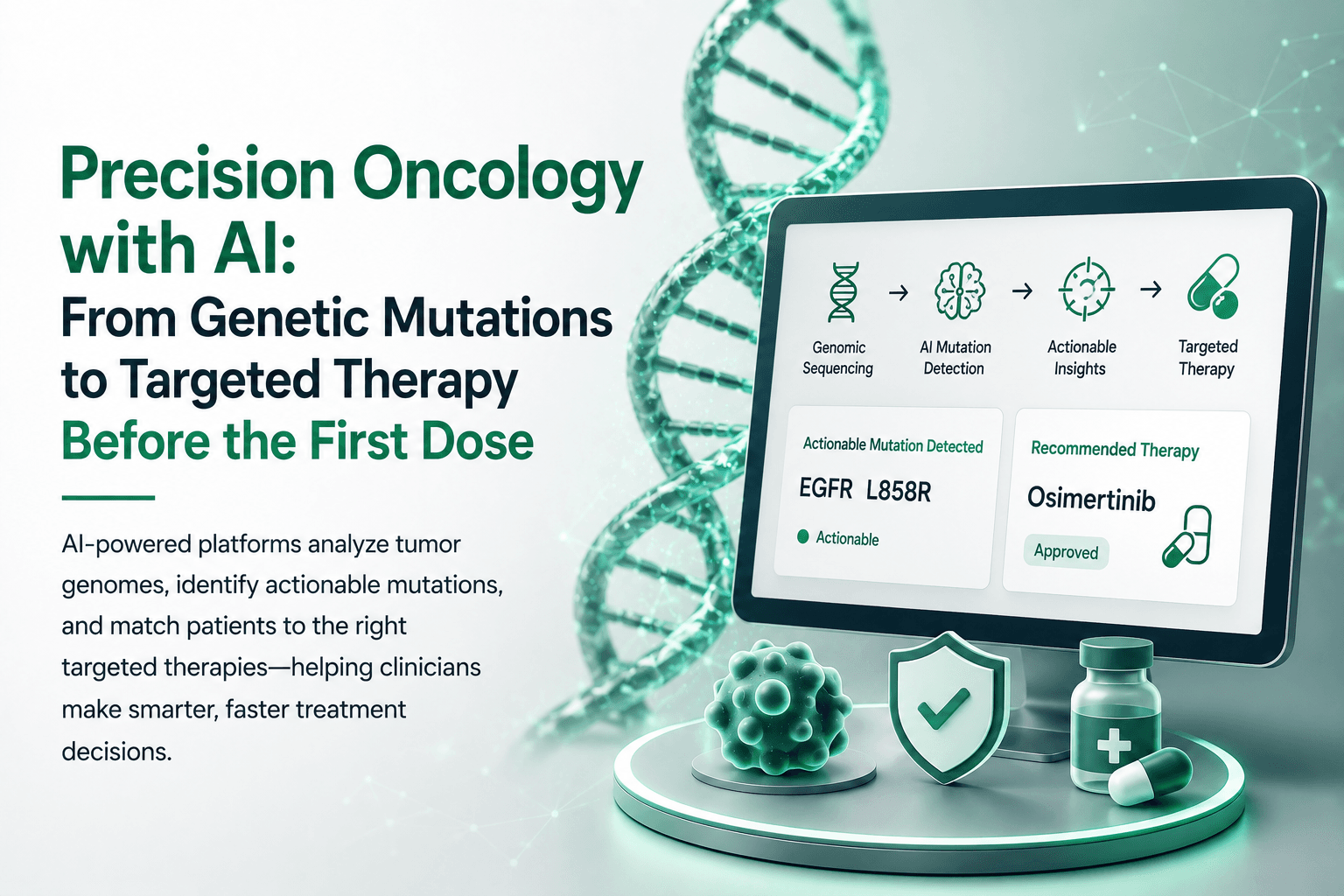
Roughly two in three patients with advanced solid tumors carry a genetic alteration that points to a targeted therapy or a clinical trial. In a 2026 real-world analysis of 3,216 patients, comprehensive genomic profiling identified actionable alterations in 67% of advanced solid tumors. The mutation is usually there. The hard part is finding it, interpreting it, and matching it to the right drug fast enough to shape the first treatment decision.
That timing is the whole game in precision oncology. A patient who starts the wrong therapy first loses months, accrues resistance, and arrives at the matched therapy sicker. AI is now compressing the path from tumor sample to a defensible therapy recommendation, before the first dose. The market reflects it: the AI in oncology segment is projected to grow from USD 1.98 billion in 2025 to USD 9.04 billion by 2030, at a 35.5% annual rate.
This article covers how AI identifies cancer mutations, how it matches them to targeted therapies, what works clinically today, and how to build the pipeline that does it at clinical-grade reliability.
What is precision oncology with AI?
Precision oncology is matching cancer treatment to the molecular profile of a patient's tumor rather than to the tumor's location alone. AI accelerates every step: it calls somatic mutations from tumor sequencing, detects biomarkers like tumor mutational burden and microsatellite instability, classifies the tumor, annotates variants against oncology knowledge bases, and matches findings to approved targeted therapies and open trials. It produces a ranked, evidence-backed recommendation for a human tumor board to review and sign off, before treatment begins.
The clinical payoff is well documented. Even when only a minority of patients historically qualified for genomically guided therapy, those treated on a matched basis showed markedly better outcomes than standard chemotherapy. AI widens that minority by surfacing actionability that manual review misses and by doing it fast.
How AI works at each stage of the precision oncology workflow
AI operates across the path from biopsy to treatment plan, and the maturity differs by stage.
| Workflow stage | What AI does | Representative tools | Maturity |
|---|---|---|---|
| Somatic variant calling | Calls SNVs, indels, CNVs, fusions from tumor reads | DeepVariant, Mutect2, Strelka2 | Production-grade |
| Biomarker detection | Computes TMB, MSI status, HRD, fusion events | Panel-specific callers, ML classifiers | Strong, validated |
| Variant interpretation | Tiers variants by clinical actionability | Varion, OncoKB, CIViC, AI classifiers | Assistive, needs review |
| Tumor classification | Predicts tumor type and origin from molecular data | ML/deep learning classifiers | Strong in research |
| Therapy and trial matching | Maps alterations to drugs and open trials | AI matching engines | Emerging, high value |
| Liquid biopsy / monitoring | Detects ctDNA, tumor fraction, residual disease | cfDNA pipelines, ML | Maturing fast |
Somatic calling is the foundation, and it is harder than germline
A tumor sample is a mix of cancer and normal cells at varying purity, often degraded by FFPE preservation, with mutations present at low allele fractions. Clinical-grade somatic pipelines use ensemble callers (Mutect2, Strelka2, VarScan2), tumor-normal pairing or a Panel of Normals, FFPE-aware filtering, and tumor purity and ploidy estimation. They are benchmarked against SEQC2 reference samples before they touch a patient report. Get this layer wrong and every downstream recommendation inherits the error.
Biomarkers decide immunotherapy eligibility
Beyond single mutations, AI computes tumor mutational burden, microsatellite instability, and homologous recombination deficiency. These genomic biomarkers (MSI-H, TMB, neoantigens) predict response to immunotherapies, and they are now standard inputs to a first-line treatment decision.
Interpretation is where AI saves the most time
A driver mutation only matters if someone connects it to a therapy. AI aggregates evidence from OncoKB, CIViC, CGI, and COSMIC, applies AMP/ASCO/CAP somatic tiering, and surfaces the variants that change management, with the supporting evidence attached.
AI therapy matching, molecular tumor boards, and the frontier
The newest and highest-value work is automated therapy matching. AI systems read a tumor's NGS profile, find actionable targets, and match each patient to optimal targeted therapies and clinical trials. In one large study, an AI platform built on 35,122 tumors across eight cancer types reached a weighted F1 score of 0.926 for high-confidence tumor-origin predictions and matched patients to therapies with significantly better survival (hazard ratio 0.326). A hazard ratio that low is a large effect: matched patients lived substantially longer.
This is reshaping the molecular tumor board. Traditionally, an MTB convenes specialists to review a case, retrieve evidence by hand, and debate options, a process measured in days. In a real-world precision oncology study, 53.6% of successfully sequenced patients had an actionable mutation identified through the tumor board workflow. AI pre-assembles the evidence dossier, the actionability tiers, and a ranked therapy list before the board meets, so specialists spend their time on judgment rather than data gathering.
Liquid biopsy is the other frontier. AI-driven cfDNA pipelines detect circulating tumor DNA, estimate tumor fraction, and monitor for minimal residual disease and early relapse from a blood draw, at allele fractions below 1%. That makes molecular profiling possible when a tissue biopsy is unavailable, and it enables monitoring across the treatment course, not just at diagnosis.
A caution that matters clinically. AI predictions are evidence, not verdicts. A 2025 study of AlphaMissense across DNA-repair genes in over 56,000 cancer patients found its accuracy is gene-dependent and still requires clinical and functional validation. In oncology, where a recommendation drives a real drug decision, every AI output needs an explainable evidence trail and human sign-off.
Before the first dose: from tumor sample to therapy recommendation
The title promises mutations identified and therapies suggested before treatment starts. Here is the sequence AI compresses, in order.
Sample to sequence. The tumor (or a blood draw for ctDNA) is sequenced on a targeted panel, exome, or genome.
Somatic calling. AI-assisted ensemble callers identify SNVs, indels, copy number changes, and fusions, filtered for FFPE artifacts and tumor purity.
Biomarker computation. TMB, MSI, and HRD are calculated as immunotherapy and PARP-inhibitor signals.
Annotation and tiering. Variants are scored against OncoKB, CIViC, and COSMIC and tiered by AMP/ASCO/CAP actionability.
Therapy and trial matching. AI maps actionable alterations to approved targeted therapies and open clinical trials.
Tumor board review. The pre-assembled dossier goes to a molecular tumor board, which verifies and signs off.
Recommendation delivered. The structured report reaches the oncologist through the EHR, before the first dose.
Done manually, this can take a week or more. Done with AI assistance on a well-engineered pipeline, the bottleneck shifts from data gathering to clinical judgment, which is exactly where the human time should go.
Why most precision oncology AI projects stall in production
A model on its own changes no treatment decisions. What determines whether AI actually helps an oncologist and a molecular tumor board is the engineering around it, and that is where most projects fail.
| Failure mode | What goes wrong | What it takes to fix |
|---|---|---|
| Weak somatic pipeline | Germline-grade calling on tumor samples produces false positives at low allele fractions | Ensemble calling, FFPE handling, and SEQC2 validation |
| Fragmented evidence sources | Variant data, knowledge bases, and trial databases live in separate systems | One governed evidence layer connecting all sources |
| Black-box recommendations | An oncologist will not act on a therapy suggestion they can't trace | Explainable, auditable output for every recommendation |
| No validation on your own cohort | Benchmark accuracy says nothing about your panels and patient population | Validation against your own data, since performance is gene-dependent |
| Dead-end delivery | A recommendation that never reaches the oncologist changes nothing | Delivery through Epic, Cerner, or the LIMS over HL7 and FHIR R4 |
Get the somatic foundation and the integration right, and the technology fades into the background, leaving the oncologist and the molecular tumor board to do what only they can: weigh the evidence and decide.
NonStop's approach: how to deploy precision oncology AI
The order is the whole game. Build the reliable somatic pipeline first, then the governed evidence layer, then explainable AI matching, then clinical delivery.
This is the engineering NonStop.io Technologies builds for oncology diagnostics labs, precision medicine companies, and cancer research programmes.
Clinical-grade somatic variant calling pipelines (Mutect2, Strelka2, VarScan2 ensembles, tumor-normal and tumor-only modes, Panel of Normals, tumor purity and ploidy, MSI and TMB calling, FFPE-aware filtering, fusion detection), all benchmarked against SEQC2.
AI-driven variant interpretation that aggregates OncoKB, CIViC, CGI, and COSMIC evidence with AMP/ASCO/CAP tiering and explainable, auditable outputs.
The ML lifecycle for tumor classification, drug response prediction, and biomarker discovery on proprietary omic data, plus liquid biopsy and ctDNA pipelines for tumor fraction and residual disease monitoring.
Results delivered into clinical workflows through HL7 v2, FHIR R4, and Mirth Connect integration with Epic, Cerner, and LIMS, on HIPAA-, SOC 2-, and GDPR-aligned infrastructure, with 90+ clients in production.
For teams building from scratch, the genomics and life sciences practice covers the pipeline, the evidence layer, the AI, and the clinical integration as one build.
Frequently Asked Questions
What is precision oncology with AI?
How does AI identify genetic mutations in cancer?
Can AI suggest targeted therapies before treatment starts?
How accurate is AI in precision oncology?
What is a molecular tumor board, and how does AI help?
Is AI-driven precision oncology HIPAA compliant?
Talk to NonStop
Book the AI Architecture Review
If you're scaling comprehensive genomic profiling or building AI-assisted therapy matching, the useful next step isn't a demo. It's an honest look at your somatic pipeline, your evidence sources, and what would have to be true for a tumor board to trust an AI-ranked recommendation. NonStop runs a 45-minute AI Architecture Review for exactly that: no pitch, just a working assessment of your sample volume, current somatic tooling, and biggest interpretation or turnaround bottleneck. Book the review and bring your hardest case.
Book the 45-Minute Review →- Comprehensive Developments | Inside Precision Medicine
- AI in Oncology Market Size, Trends, Share & Industry Report 2031
- Comprehensive Genomic Profiling Across Diverse Solid Tumors: A Real-World Experience From India With FoundationOne®CDx Testing — PMC
- From Genomics to AI: Revolutionizing Precision Medicine in Oncology
- OncoGPT: An AI assistant for genomic-driven precision oncology | Journal of Clinical Oncology
- Impact of molecular diagnostics and targeted cancer therapy on patient outcomes (MODIFY): a retrospective study of the implementation of precision oncology — PMC
- AlphaMissense for Identifying Pathogenic Missense Mutations in DNA Damage Repair Genes in Cancer — PMC
Through our blogs, we share practical insights on healthcare, genomics, bioinformatics, AI, digital transformation, product engineering, and emerging technologies. Our goal is to help technology leaders make informed decisions and build products that are ready for long-term growth.