
Newsletter
NonStop:
Genomics & Healthcare Digest
February 2025 | AI in Clinical Genomics: From Hype to Production


CEO’s Message
Welcome to our second edition of NonStop’s Healthcare & Genomics Digest.
AI in genomics is moving fast, and in many conversations lately, the question isn’t if to adopt it but what’s actually working in production. In this issue, we’re sharing what we’re seeing firsthand across real clinical environments.
I’ll be at PMWC in Silicon Valley from March 4–6 and at ACMG in Baltimore from March 11-13. If you’re attending, I’d love to connect and exchange notes on where genomics platforms and AI are truly heading.
Thank you for being part of this journey with us.
Saurabh Gawande,
CEO, NonStop io Technologies
.png)
AI in Genomics:
How Automation is Transforming Clinical Decisions
If you've been watching the AI hype in genomics, you're probably wondering what's real versus vaporware. Clinical genetic testing labs face two critical bottlenecks: variant interpretation remains labor-intensive (even experienced geneticists can spend hours per variant), and NGS quality control requires manual review of complex data outputs.
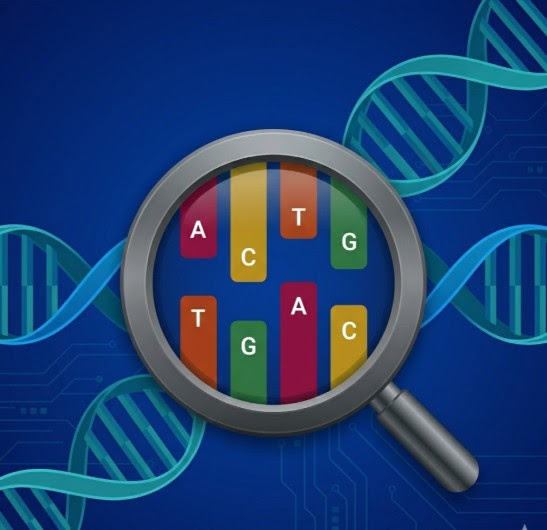
AI-Powered Variant Calling: DeepVariant and DRAGEN Lead the Way
Google's DeepVariant has emerged as a benchmark in AI-driven variant calling. The tool reframes variant detection as an image classification problem, using deep neural networks. A peer-reviewed study (1)comparing DeepVariant with GATK in clinical trio exome samples found that DeepVariant achieved a shorter execution time, lower Mendelian error rate, and higher Ti/Tv ratio (2.38 vs 2.04).
Illumina's DRAGEN represents another major AI-powered platform. A study published in Nature Biotechnology (October 2024)(2) validated DRAGEN's germline algorithms, demonstrating superior performance compared to eight other variant calling programs. DRAGEN v4.4 (May 2025)(3) achieves higher accuracy using PrecisionFDA Truth Challenge v2 benchmark data, with a 30% improvement in structural variant calling and 20% boost in SNV/indel calling accuracy.
The University Hospital of Tübingen has selected DRAGEN for a pioneering study to evaluate clinical utility in WGS germline testing, a sign of growing clinical adoption.
.jpg)
AI for NGS Quality Control: seqQscorer and MultiQC AI Summaries
Quality control in NGS workflows has traditionally required manual interpretation of FastQC outputs. AI is automating this bottleneck.
seqQscorer, published in Genome Biology (2021) (4), uses machine learning to predict NGS data file quality. The system benchmarked 10 machine learning algorithms on ENCODE data and found that combined feature models systematically outperformed individual FastQC features.
Seqera's MultiQC AI Summaries (released January 2025) (5) represents a significant development. AI Summaries allow MultiQC users to generate automated summaries of their reports.
The Architecture Reality
These capabilities don't drop into existing platforms. You need:
Model versioning infrastructure is must
Require self-healing orchestration
Needs a validation framework
What's Still Not Ready
LLMs for reports
Hallucinate references, misinterpret guidelines. Not clinical-grade.
Continuous learning
FDA requires locked post-validation models..
Automated genetic counseling
AI assists; it doesn't replace counselor expertise for complex cases.
Explainable variant prediction, autonomous QC, and generative editing optimization are genuinely production-ready in 2026. But they require platform architecture designed for AI: versioning, explainability infrastructure, validation frameworks, and AI-specific monitoring.
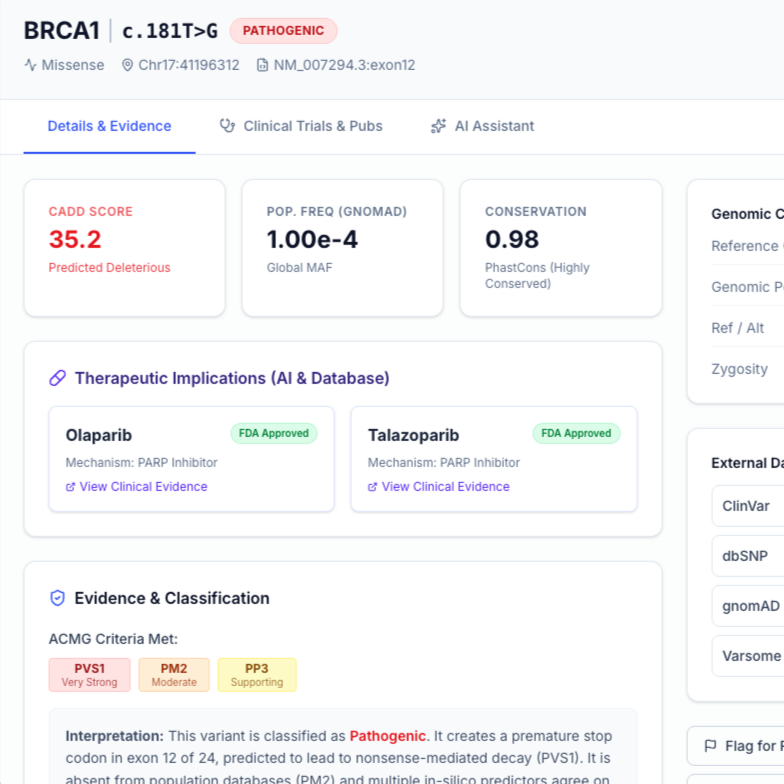
From Our Lab: New AI Tools for Genomics
.jpg)
Sources
- Scientific Reports (2022). "Comparison of GATK and DeepVariant by trio sequencing." doi: 10.1038/s41598-022-05833-4
- Behera S, et al. "Comprehensive genome analysis and variant detection at scale using DRAGEN." Nature Biotechnology (2024). doi: 10.1038/s41587-024-02382-1
- Illumina Press Release, May 13, 2025. "Illumina DRAGEN v4.4 powers clinical oncology research."
- Sprang M, et al. "seqQscorer: automated quality control of next-generation sequencing data using machine learning." Genome Biology (2021). doi: 10.1186/s13059-021-02294-2
- Seqera Blog (January 2025). "AI Summaries now available in MultiQC."


