
What They Do
The client operates in the EdTech space, supporting digital and hybrid learning environments. As lecture content increasingly shifted to recorded and live-streamed formats, they identified a core learning gap.
Students were consuming content, but not effectively understanding or retaining it.
Traditional tools stopped at video playback and manual note-taking. The client wanted to go further by using AI to actively interpret lecture content and support students the way a human teaching assistant would.
This required more than transcription. It required AI systems capable of understanding context, importance, and learning intent.
The Challenge
For this client, the challenge was not just converting audio to text. It was:
- Identifying what matters in a lecture
- Structuring unstructured speech into learning-ready formats
- Reducing cognitive load for students
- Doing this reliably across subjects, instructors, and formats
- Scaling without manual intervention
The client needed an AI-driven comprehension layer on top of raw lecture content.
NonStop Solution
Designing and Implementing AI as the Core System
NonStop was responsible for end-to-end AI product implementation, including:
- AI strategy and system design
- Model orchestration across transcription, NLP, and generative layers
- Backend pipelines for scalable processing
- Explainable AI outputs suitable for learners
- Deployment-ready architecture for real-world use
This was treated as an AI system, not a content feature.
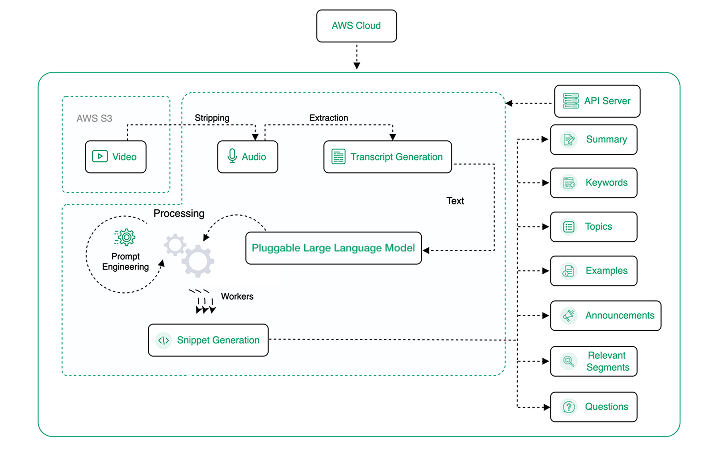
How NonStop Implemented AI in iVTA
1. AI-First Architecture Design
NonStop designed iVTA as a multi-stage AI pipeline, where each AI component had a clear responsibility:
- Capture
- Interpret
- Structure
- Explain
This ensured AI outputs were meaningful, not noisy.
2. Speech-to-Text as the Entry Point (Not the End)
AI-based transcription models were used to convert live and recorded lectures into text.
But unlike basic transcription tools, this output was treated as raw input for downstream AI reasoning, not the final product.
3. NLP Models for Content Understanding
Using LLaMA 2 and Hugging Face NLP models, NonStop implemented:
- Topic identification to segment lectures logically
- Keyword extraction to surface core concepts
- Relevant segment detection to identify explanations, examples, and emphasis points
- Announcement extraction to separate administrative content from learning content
This step transformed transcripts into structured learning artifacts.
4. Generative AI for Learning-Oriented Summaries
NonStop integrated Generative AI (OpenAI / ChatGPT) to convert structured outputs into:
- Concise lecture summaries
- Clear explanations of complex concepts
- Highlighted examples that reinforce understanding
Guardrails were applied to ensure:
- No hallucination
- Faithful representation of instructor intent
- Educational tone and clarity
The goal was decision-grade learning content, not generic summaries.
5. Focus-of-Inquiry Intelligence
AI logic was applied to identify:
- Likely areas of confusion
- Concepts emphasized repeatedly
- Sections requiring deeper attention
This helped students prioritize revision and ask better questions, something traditional tools cannot do.
6. Scalable AI Processing Pipeline
To make this AI system production-ready, NonStop implemented:
- FastAPI for orchestration and APIs
- RabbitMQ + Celery for asynchronous processing of large audio/video files
- AWS EC2 & S3 for scalable compute and storage
This ensured the system could handle high volumes of lectures across courses and institutions without performance degradation.
7. The Resulting AI System
The Intelligent Virtual Teaching Assistant (iVTA) functioned as a learning-aware AI layer that:
- Interprets lectures the way a teaching assistant would
- Structures content for different learning needs
- Reduces reliance on manual note-taking
- Improves comprehension without changing how instructors teach
Impact
AI That Changes Learning Behavior, Not Just Content Access
The AI-driven platform enabled the client to:
- Eliminate manual note-taking for students
- Improve comprehension through structured, AI-curated summaries
- Enable focused learning using AI-highlighted key concepts and examples
- Reduce repeated lecture replays
- Support diverse learning styles at scale
Students moved from passive listening to active understanding.
Why NonStop
This case study highlights NonStop’s ability to:
- Design AI-first system architectures
- Orchestrate multiple AI models into a single product
- Translate complex AI outputs into usable experiences
- Move from AI experimentation to applied intelligence
- Deliver production-ready AI systems in regulated, real-world domains
Want to Build AI-Driven Learning Platforms?
At NonStop, we help EdTech teams design and build AI systems that understand content, context, and users, not just process data. If you’re exploring AI for learning, comprehension, or engagement, we help you move from ideas to systems that actually work.
Client Testimonial


