
Eliminating the Manual Bottleneck: How AI Transformed Clinical Document Processing
What They Do
The client is a leading provider of diagnostic healthcare services, operating a large-scale clinical laboratory that processes high volumes of patient orders across multiple service lines. Their workflows span patient intake, test ordering, and results management, all of which depend on accurate, timely data entry to ensure operational continuity and patient safety.
Services Delivered
End-to-End AI Product Development
AI Strategy · Document Intelligence · OCR Pipeline Engineering · Vision-Language Model Integration · Validation Layer Design · Human-in-the-Loop Workflow · System Integration & Testing
Technology Stack
- Frontend: ReactJS
- Backend & APIs: FastAPI
- AI & ML: OCR, VLM, Hugging Face
- Async Processing: RabbitMQ, Celery
The Challenge
Manual Data Entry as a Bottleneck to Growth
The client receives a significant portion of patient orders as hand-filled paper forms, submitted physically or as scanned and photographed images. Each form spans multiple pages and contains a mix of printed field labels, handwritten patient data, checkboxes, radio buttons, and multi-section clinical checklists.
Their current intake workflow requires two staff members to process every single form. The first person reads the paper form and manually types all required fields into the order management system. A second person then independently verifies the entered data against the original form, checking for transcription errors before the order can proceed. This two-step manual verification process exists to ensure accuracy, but it doubles the human effort required for every order and creates a significant operational bottleneck at scale.
As order volumes grew, this compounding dependency on two-person manual handling created serious challenges:
- Every form required two separate rounds of human attention before it could move forward
- Handwritten content introduced transcription errors that the verification step itself could not always catch
- No existing system could interpret form structure or understand the relationship between field labels and handwritten responses
- Skilled staff time was consumed entirely by a repetitive, low-value transcription task
The client needed an automated pipeline that could ingest form images, accurately extract key fields, validate the output, and feed structured data directly into the order management system, eliminating the need for both manual entry and manual verification.
The NonStop Solution
Moving from Manual Data Entry to Intelligent Document Processing
We designed and built an end-to-end intelligent document processing pipeline that transforms scanned or photographed patient forms into structured, validated, system-ready data. The core challenge was to handle the full complexity of real-world medical forms.
Where AI Makes the Difference
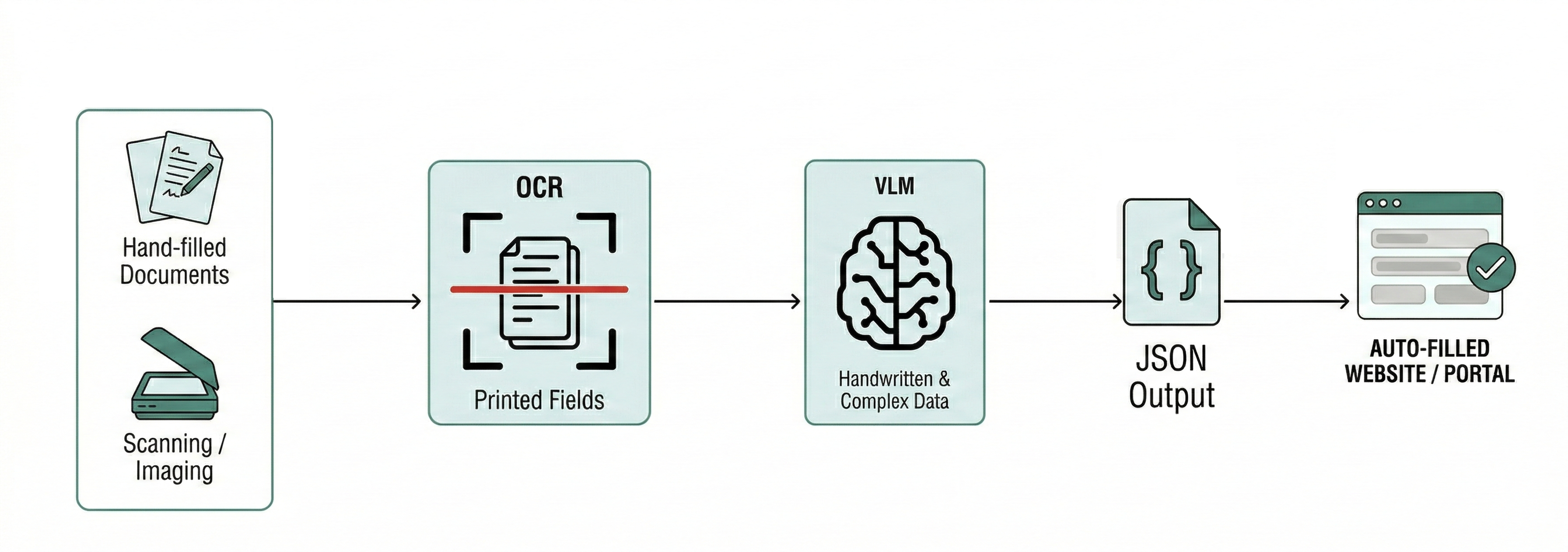
Hybrid OCR + VLM extraction engine, we implemented a two-layer extraction approach because the forms contain both clean printed fields and complex handwritten entries that behave very differently under extraction.
Semantic form understanding, one of the root causes of failure in traditional OCR pipelines is that they read text but do not understand documents. We addressed this by making the VLM layer the semantic backbone of the system.
Automated entry and verification in a single pass, the client's existing workflow required two people per form: one to enter data and one to verify it. We replaced this entirely by building validation directly into the extraction pipeline. Every extracted field is automatically confidence-scored and cross-checked against format and business rules before it ever reaches the order system.
End-to-end system integration, to close the loop, we connected the pipeline directly to the client's order management system via API. Extracted fields are mapped to the target schema automatically, so validated data flows into the system without any manual re-entry, making the entire workflow continuous and auditable end to end.
The Impact
From Patient Forms to Automated Order Intake
The AI-driven solution enabled the client to:
- Eliminate the two-person entry and verification bottleneck, freeing skilled staff from repetitive, low-value transcription tasks
- Reduce manual review to a fraction of total document volume through confidence-based automation
- Scale document processing without increasing operational headcount
Why This Matters for Healthcare Document Workflows
Demonstrates how AI replaces brittle, rule-based extraction with semantic document understanding. Shows the limitations of traditional OCR when applied to variable, handwritten medical forms. Highlights the value of combining OCR and VLMs in a production-grade hybrid architecture. Emphasizes accuracy, trust, and human oversight through confidence scoring and review workflows. Proves AI can deliver measurable operational impact in high-stakes clinical environments.
Client Testimonial


