
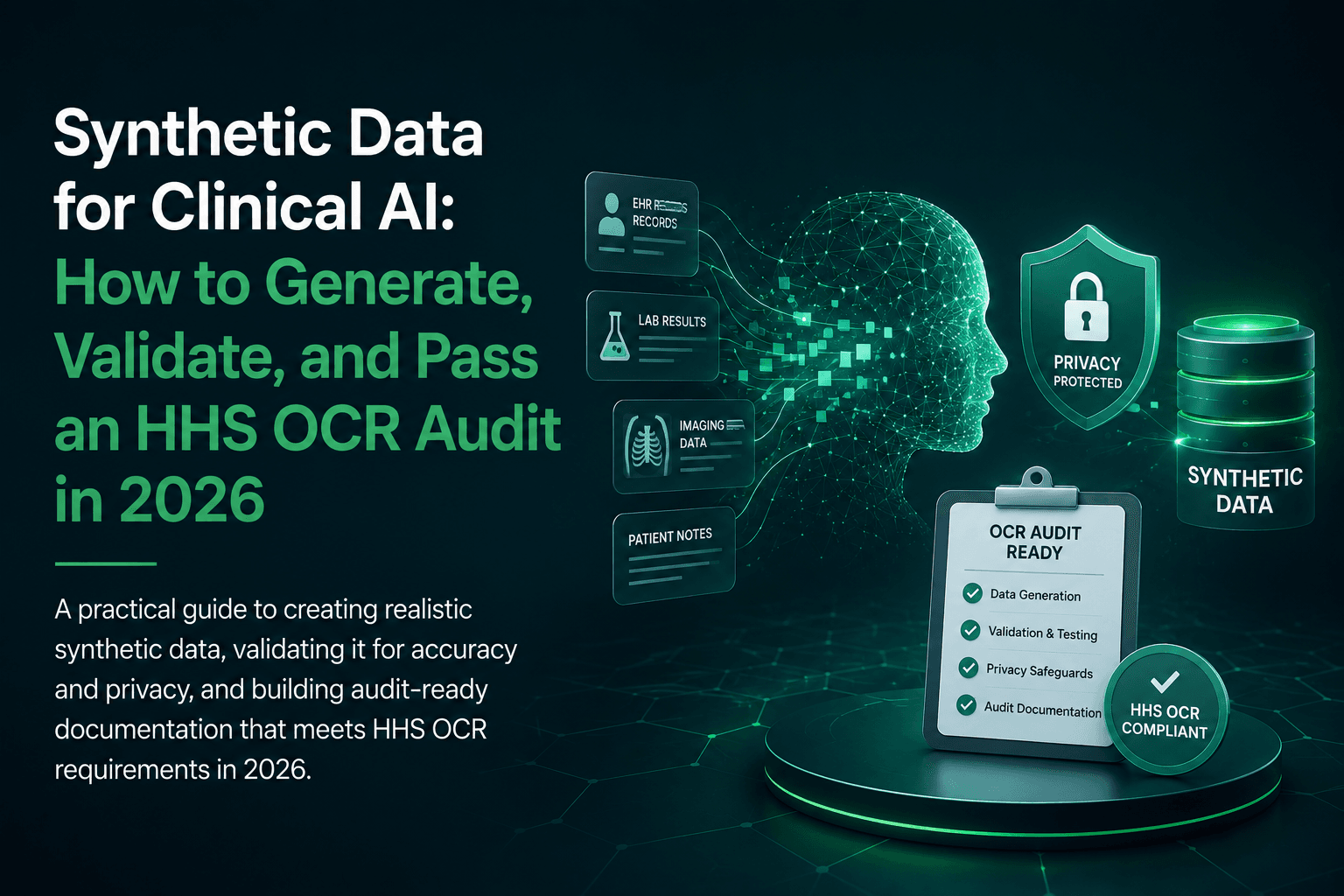
Synthetic Data for Clinical AI: Generate, Validate, and Prepare for an HHS OCR Audit in 2026
Synthetic data has become a common solution for clinical AI teams that need training data, partner-shareable datasets, or test environments without directly exposing protected health information.
When implemented correctly, synthetic data can reduce the time required to launch AI pilots and remove a major regulatory barrier. When implemented poorly, it may still expose real patient information and create significant HIPAA risk.
This guide explains how to generate synthetic clinical data, validate it, and prepare the documentation required to defend the program during an HHS Office for Civil Rights audit.
It is intended for CIOs, privacy officers, CTOs, and data-engineering leaders who are running or preparing to launch a synthetic-data program.
What Synthetic Clinical Data Is and Why It Is Not the Same as Anonymized Data
Synthetic clinical data is generated by a model trained on real patient records. The model produces new records that statistically resemble the source population without directly reproducing real patients.
The resulting data may be used for AI training, software validation, partner sharing, clinical-trial simulation, and analytics.
Synthetic data is not the same as anonymized data. Anonymization removes or transforms identifiers in real records. Synthetic generation creates new records that did not previously exist.
The legal distinction matters. De-identified data may follow HIPAA Safe Harbor or Expert Determination pathways. Properly generated synthetic data may fall outside HIPAA only when the organization can demonstrate that individual information is not retained, reconstructable, or inferable.
Without documented proof that individual information cannot be recovered, synthetic data should be treated as potentially regulated data.
Clinical AI teams should also account for evolving HHS audit priorities, business-associate oversight, Security Rule expectations, and sensitive data categories such as substance-use-disorder information.
For teams training AI on patient information, the documentation package proving privacy, lineage, validation, and governance is one of the most important artifacts in the engineering stack.
Five Synthetic Clinical Data Generator Categories
Several generator categories are used in production healthcare environments. The correct choice depends on data modality, use case, privacy requirements, and the expected level of statistical fidelity.
1. Generative Adversarial Networks
GANs are widely used for tabular EHR generation. CTGAN is a common open-source baseline, while commercial platforms provide managed implementations.
GANs can model mixed-type clinical tables effectively, but they may be sensitive to training instability and can memorize rare records if not validated carefully.
2. Variational Autoencoders
VAEs are well suited to smaller datasets and lower-cardinality features.
They are generally faster and more stable to train than GANs, although fidelity may be lower for highly correlated clinical variables.
3. Diffusion Models
Diffusion models have expanded from imaging into tabular data.
They are useful for conditional generation, such as creating synthetic cohorts that match specific clinical phenotypes.
4. Bayesian Networks and Rule-Based Generators
Rule-based and probabilistic generators such as Synthea are useful when clinically plausible longitudinal records and population-level patterns are more important than record-level realism.
5. Large Language Models
Large language models are increasingly used for synthetic clinical narratives such as discharge summaries, progress notes, and radiology reports.
Because hallucination and factual inconsistency are possible, synthetic narrative data requires additional validation beyond the checks used for tabular data.
Many production programs combine multiple approaches, such as a rule-based generator for longitudinal structure, a tabular model for high-fidelity attributes, and a language model for selected free-text fields.
How to Validate Synthetic Healthcare Data
A synthetic dataset should be validated across privacy, fidelity, and utility before it is released.
Validating only one of these categories is a common failure mode.
1. Privacy Validation
The organization must demonstrate that real patient information cannot be recovered from the synthetic dataset.
- Membership-inference testing: Test whether an attacker can determine whether a specific record appeared in the training data.
- Attribute-disclosure testing: Test whether quasi-identifiers allow sensitive attributes about real individuals to be inferred.
- k-anonymity and l-diversity: Measure risk across the documented quasi-identifier set.
- Differential privacy: Document the privacy budget when differential privacy is used.
Common tools include Anonymeter, TAPAS, MOSTLY AI, Replica Analytics, and Tonic.ai.
2. Fidelity Validation
Fidelity testing determines whether the synthetic dataset statistically resembles the real population.
- Column-level distribution tests
- Kolmogorov-Smirnov testing for continuous values
- Chi-squared testing for categorical values
- Wasserstein-distance measurement
- Pairwise and higher-order correlation preservation
- Conditional-distribution analysis for clinically important features
Common tools include SDMetrics and table-evaluator.
3. Utility Validation
Utility testing determines whether the synthetic data supports the intended downstream clinical AI task.
- Train on synthetic, test on real: Train the model on synthetic data and evaluate it on a held-out real dataset.
- Subgroup performance: Compare performance across race, ethnicity, age, sex, and rare clinical phenotypes.
- Rare-event preservation: Confirm that clinically important but uncommon patterns were not lost during generation.
A dataset that passes privacy testing but fails utility testing may be unusable. A dataset that passes utility testing but fails privacy testing creates significant risk because teams may distribute it widely before leakage is discovered.
Seven Artifacts for HHS OCR Audit Readiness
OCR investigators typically begin with documentation, governance, and access-control evidence rather than model architecture.
1. Expert Determination Report
Maintain a formal report from a qualified expert describing the methodology, privacy-risk thresholds, residual disclosure risk, and the conclusion reached.
Refresh the report when source data changes, the generator changes, or on a defined periodic schedule.
2. Generation Methodology Specification
Document the generator architecture, training-data scope, hyperparameters, privacy controls, differential-privacy settings, and rejection criteria for unstable runs.
3. Privacy Validation Report
Store the results of membership-inference, attribute-disclosure, k-anonymity, l-diversity, and related privacy tests for every approved release.
4. Fidelity and Utility Validation Report
Preserve distribution testing, correlation analysis, conditional-distribution checks, and downstream model-utility results.
5. Bias and Subgroup Performance Report
Measure subgroup representation and model performance, and document mitigation when underrepresentation or collapse is detected.
6. Provenance and Lineage Trail
Link every synthetic dataset to the generator version, training-data snapshot, validation runs, approvals, and downstream consumers.
This lineage should be maintained in a governed platform or data catalog rather than an unmanaged spreadsheet.
7. Workforce and Access-Control Evidence
Maintain training records, minimum-necessary access controls, business-associate agreements, and source-PHI access logs for the generator-training process.
Many audit findings arise from the access patterns used to produce the synthetic data rather than from the synthetic dataset itself.
Three Synthetic Data Failure Patterns That Create HIPAA Risk
1. Outsourced Generation With Retained Liability
Using a third-party synthetic-data vendor does not eliminate the covered entity’s or business associate’s responsibility.
The organization remains accountable for vendor controls, validation methodology, access patterns, and contractual protections.
2. Validation Performed Only at Initial Release
A generator may be validated once and then reused for months while source data, distributions, or workflows change.
Without recurring validation, later datasets may no longer represent the intended population or preserve the required privacy characteristics.
3. An Inadequate Expert Determination
A short legal-style memo without methodology, test results, thresholds, and residual-risk analysis is unlikely to provide sufficient technical support during an audit.
Expert determinations should read like complete statistical and privacy-risk reports.
The Business Case for a HIPAA-Aligned Synthetic Data Program
A defensible synthetic-data program may require several weeks of infrastructure, governance, validation, and documentation work, followed by recurring validation for each approved release.
The cost of implementing the program incorrectly can include regulatory penalties, corrective-action plans, delayed partnerships, and the loss of buyer or patient trust.
When implemented correctly, a synthetic-data program can help teams:
- Train models without broadly distributing source PHI.
- Share datasets with academic and research partners under controlled agreements.
- Evaluate AI vendors without exposing production data.
- Accelerate software testing and model prototyping.
- Simulate clinical-trial or operational scenarios.
- Reduce the time required to launch new AI initiatives.
How NonStop Builds Synthetic Data Platforms for Clinical AI
NonStop builds end-to-end synthetic-data programs for clinical AI companies, health systems, and biopharma teams operating under HIPAA and other healthcare and AI-governance frameworks.
Engagements may include generator selection, privacy controls, validation pipelines, lineage, bias analysis, access governance, documentation, and audit-readiness artifacts integrated directly into the data platform.
References
- HHS HIPAA Compliance Enforcement and Audit. View source
- HIPAA Journal. OCR’s third phase of HIPAA compliance audits. View source
- MOSTLY AI Engine. View source
- TabDDPM reference. View source
- Synthea. View source
- SDMetrics. View source

Through our blogs, we share practical insights on healthcare, genomics, bioinformatics, AI, digital transformation, product engineering, and emerging technologies. Our goal is to help technology leaders make informed decisions and build products that are ready for long-term growth.