
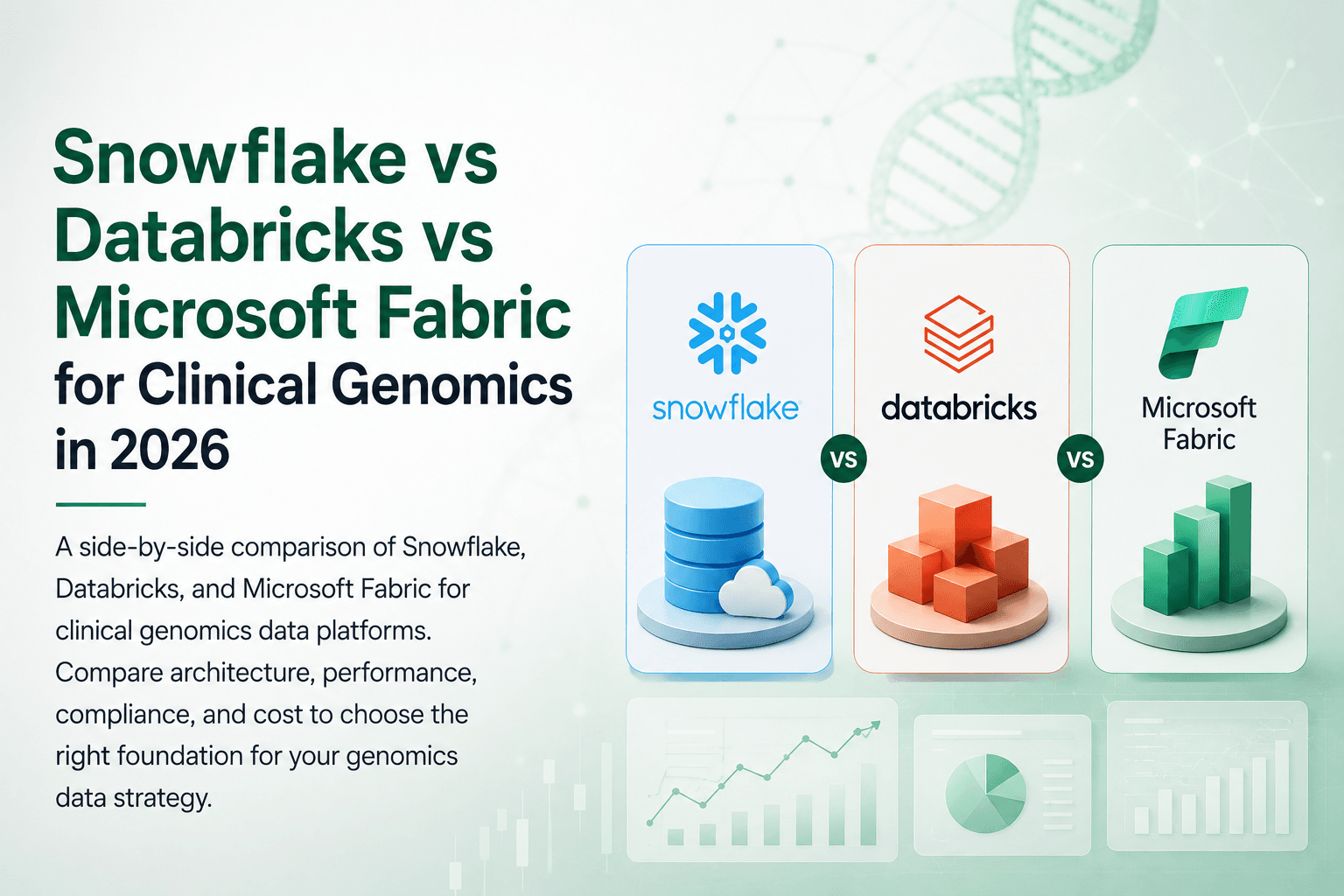
Snowflake vs. Databricks vs. Microsoft Fabric for Clinical Genomics in 2026
If you are a CTO, vice president of bioinformatics, or CIO choosing a clinical genomics data platform in 2026, the decision has changed.
Apache Iceberg v3 unified important lakehouse-storage capabilities. Microsoft Fabric and Snowflake improved interoperability with Iceberg, while Databricks continued expanding healthcare, life-sciences, and AI capabilities.
Each platform now presents itself as AI-native, lakehouse-native, and healthcare-ready. However, they remain meaningfully different for clinical genomics workloads such as population-scale VCF processing, FHIR ingestion, regulated traceability, and AI on internal data.
This guide compares the three platforms specifically for clinical genomics rather than through a generic data-platform feature matrix.
Quick Platform Fit Summary
| Use Case | Best Fit | Why |
|---|---|---|
| Population genomics, VCF processing at scale, and machine learning on omic data | Databricks | Strong distributed processing, Spark-oriented genomics workflows, and a broad machine-learning platform. |
| Clinical analytics, real-world evidence, multimodal and multi-omic clinical data, and governed sharing | Snowflake | Strong governed analytics, structured querying, and cross-organization data-sharing capabilities. |
| Microsoft-native health systems, FHIR-first analytics, OMOP CDM, and embedded business intelligence | Microsoft Fabric | Strong fit for organizations already standardized on Azure, Microsoft 365, and Power BI. |
These are starting points rather than absolute verdicts. The complete comparison follows.
What Changed in Clinical Genomics Platform Selection in 2026
1. Iceberg and Lakehouse Interoperability Improved
Storage-format interoperability reduced the need to choose a platform solely around Iceberg or Delta-compatible storage.
Data can increasingly remain in place while different engines query or process it.
2. AI Moved Closer to Governed Data
Snowflake Cortex AI, Databricks Mosaic AI, and Microsoft Fabric Copilot allow organizations to apply AI capabilities to governed platform data without building an entirely separate stack.
3. Healthcare Verticalization Matured
Each vendor expanded healthcare-specific reference architectures, accelerators, data models, and partner ecosystems.
The decision is no longer which lakehouse to choose in isolation. It is which lakehouse fits each clinical genomics workload.
Seven Criteria That Decide Which Platform Fits Clinical Genomics
1. VCF and Unstructured Genomic Data Handling
Databricks
Databricks is the strongest fit when genomic-scale processing is central. Spark-based processing, Delta Lake, Glow, Hail, and custom pipelines provide a natural path for VCF transformation and large-scale variant analytics.
Snowflake
Snowflake performs well for structured variant analytics and governed querying, but raw NGS workflow integration is generally less natural than in Databricks.
Microsoft Fabric
Fabric can store genomic files in OneLake and process them through Spark, but it offers fewer genomics-specific tools by default.
Best fit: Databricks for genomics-heavy workloads.
2. Clinical Data Ingestion: FHIR, HL7, and DICOM
Microsoft Fabric
Fabric provides the most opinionated Microsoft-native path for FHIR, imaging, OMOP, and medallion-style healthcare analytics.
Snowflake
Snowflake supports clinical data well through connectors, partners, and custom ingestion patterns, although direct FHIR ingestion often requires additional implementation work.
Databricks
Databricks usually relies on custom Spark pipelines, healthcare reference architectures, or implementation partners for FHIR and HL7 ingestion.
Best fit: Microsoft Fabric for FHIR-first analytics.
3. AI and Machine Learning on Internal Data
Databricks
Databricks provides the broadest platform for custom model development, experiment tracking, model serving, vector search, and GPU-enabled workflows.
Snowflake
Snowflake is strong for governed inference, natural-language querying, and AI-assisted analytics, but it is generally less centered on custom model training.
Microsoft Fabric
Fabric integrates well with Microsoft AI services and Power BI, making it attractive for embedded AI and analytics experiences.
Best fit: Databricks for model training; Snowflake or Fabric for AI-assisted analytics.
4. Compliance Posture for Clinical Genomics
All three platforms can support HIPAA-eligible architectures and enterprise compliance programs. The practical difference is how naturally each fits the organization’s governance ecosystem.
Databricks
Unity Catalog, lineage, and MLflow support governed data and model traceability.
Snowflake
Snowflake provides mature sharing controls and strong governance for structured clinical datasets and cross-organization collaboration.
Microsoft Fabric
Fabric aligns closely with Microsoft Purview, Entra ID, and the broader Microsoft compliance stack.
Best fit: Choose according to the compliance ecosystem your organization already operates.
5. Cost Model at Biobank Scale
Snowflake
Credit-based pricing is relatively predictable for analytics, but petabyte-scale genomic storage and repeated processing require careful workload controls and architecture.
Databricks
Cost varies with compute size, runtime, features, and cluster configuration. It can be efficient for bursty workloads when governance and cost controls are strong.
Microsoft Fabric
Capacity-based pricing can be easier to budget for moderate-scale and steady workloads, though it may be less efficient for highly spiky genomics compute.
Best fit: Fabric for predictable capacity cost; Databricks for variable compute with disciplined controls.
6. Data Sharing and Federation
Snowflake
Secure Data Sharing remains a strong option for governed collaboration with research partners and external organizations.
Databricks
Delta Sharing provides an open approach to cross-platform data sharing and can reduce dependence on a single vendor.
Microsoft Fabric
OneLake shortcuts support zero-copy access across supported external storage systems and can simplify multi-cloud federation.
Best fit: Snowflake for cross-organization sharing; Fabric for Microsoft-centered multi-cloud federation.
7. Migration From On-Premises HPC and Legacy LIMS
Databricks
Databricks provides strong patterns for moving computational genomics pipelines from HPC environments into a governed lakehouse.
Snowflake
Iceberg external tables can allow legacy data to remain in object storage while becoming queryable through Snowflake.
Microsoft Fabric
Fabric is most straightforward when the organization already uses Azure, Microsoft identity, and Power BI.
Best fit: Databricks for genomics-focused HPC-to-lakehouse migration.
How to Choose Between Snowflake, Databricks, and Microsoft Fabric
Skip the generic feature matrix and answer three questions.
1. Where Does AI Sit in Your Roadmap?
- Databricks: Custom machine-learning training on genomic data
- Snowflake: Natural-language analytics, AI-augmented BI, and governed agentic workflows
- Microsoft Fabric: Embedded AI in Power BI and Microsoft 365
2. Where Does Your Existing Compliance and IT Investment Live?
- Databricks: AWS-heavy, open-source-oriented, and machine-learning-team-led environments
- Snowflake: Multi-cloud, governance-first, analytics-led environments
- Microsoft Fabric: Microsoft 365, Azure, Power BI, and Microsoft governance environments
3. What Is the Dominant Data Type?
- Databricks: VCF, BAM, FASTQ, single-cell, imaging, and other computationally heavy data
- Snowflake: Clinical, real-world evidence, biomarker, and governed multimodal datasets
- Microsoft Fabric: FHIR-first, OMOP-centered, Power BI-driven clinical analytics
If all three answers point to one platform, the decision is relatively straightforward. If they split, a hybrid architecture may be the correct design.
When a Hybrid Architecture Wins
Large clinical genomics organizations increasingly use two platforms rather than forcing every workload into one.
Databricks Plus Snowflake
Use Databricks for genomic processing and machine learning, and Snowflake for governed clinical analytics and external sharing.
Microsoft Fabric Plus Databricks
Use Fabric for FHIR ingestion and Microsoft analytics, and Databricks for machine learning and omic processing.
Snowflake Plus Databricks for AI Training
Use Snowflake for governed clinical data and Databricks for custom AI training and computational genomics.
Hybrid is not a failure mode. It can be the correct architecture for organizations spanning genomic research, clinical operations, and external collaboration.
What This Means for Clinical Genomics CTOs
- Choose Databricks when genomics processing and custom machine learning are the center of gravity.
- Choose Snowflake when governed analytics, real-world evidence, and data sharing are the center of gravity.
- Choose Microsoft Fabric when the organization is deeply invested in Microsoft and FHIR-first analytics.
- Choose a hybrid architecture when two of those conditions are equally important.
The platform decision matters, but the data model, pipeline design, governance architecture, and AI readiness of the underlying data layer matter more.
How NonStop Builds Clinical Genomics Data Platforms
NonStop builds clinical genomics data platforms on Databricks, Snowflake, Microsoft Fabric, and AWS HealthOmics.
The team supports migration from on-premises HPC and legacy LIMS, hybrid lakehouse architecture, large-scale variant processing, FHIR ingestion, governed analytics, and AI-ready data layers.
Frequently Asked Questions
Which platform is best for clinical genomics in 2026?
Databricks is generally the strongest fit for large-scale genomic processing and custom machine learning. Snowflake is strong for governed clinical analytics and secure sharing. Microsoft Fabric is attractive for Microsoft-native organizations with FHIR-first workloads.
What changed in 2026 that affects this decision?
Lakehouse interoperability improved, AI capabilities moved closer to governed platform data, and healthcare-specific accelerators became more mature across all three vendors.
Why is Databricks often preferred for genomics-heavy workloads?
Databricks provides strong distributed processing, Spark-based genomics workflows, flexible lakehouse architecture, and a broad platform for custom model development.
When does Microsoft Fabric win?
Fabric is strongest when an organization already uses Microsoft 365, Azure, Power BI, Microsoft governance services, and FHIR-centered clinical analytics.
Is a hybrid Snowflake, Databricks, and Microsoft Fabric architecture viable?
Yes. Hybrid architectures are increasingly practical when genomic processing, governed analytics, clinical ingestion, and external collaboration require different platform strengths.
Through our blogs, we share practical insights on healthcare, genomics, bioinformatics, AI, digital transformation, product engineering, and emerging technologies. Our goal is to help technology leaders make informed decisions and build products that are ready for long-term growth.