
%201.jpg)
Over the last decade, genomics has moved from research-only environments into clinical workflows, and the digital infrastructure supporting that shift has struggled to keep up. The NIH has repeatedly highlighted the exponential growth of sequencing output, and the U.S. Office of the National Coordinator for Health IT (ONC) continues to emphasize that genomic results must be handled with the same rigor as any HIPAA-regulated clinical data. Meanwhile, the CDC notes that genomic data, because of its inherent identifiability, carries unique privacy risks not present in traditional lab data.
Yet in our work across genomics companies, health systems, and precision medicine programs, one pattern stands out:
Most teams underestimate what it truly means to build a HIPAA-ready genomics platform.
They underestimate the architectural implications, the data-layer controls, the cross-system dependencies, the cloud posture required, and the operational guardrails needed to maintain compliance as pipelines scale.
This article is written for leaders evaluating vendors, choosing internal architectures, or planning modernization: Directors and VPs of Genomics, Bioinformatics leads, LIMS managers, CTOs, CIOs, Digital Health founders, and precision medicine teams who need a clear, technically rigorous roadmap.
By the end, you'll have a complete framework for developing (or buying) a HIPAA-aligned genomics platform supported by architecture patterns, compliance considerations, common mistakes, and implementation best practices rooted in real-world workflows.
Genomic data is different.
Unlike standard clinical attributes, age, diagnosis codes, and labs, DNA data is intrinsically identifiable. Even pseudonymized VCF files can be reidentified with moderate computational effort when cross-referenced with public genomic datasets. This reality drives stricter interpretations of the HIPAA Security Rule for genomics-heavy platforms.
Common triggers that increase security scope include:
Whole Genome Sequencing (WGS) or Whole Exome Sequencing (WES) output
Long-term archival of FASTQ/CRAM files
AI/ML model training on genomic + clinical combined datasets
Cross-entity data exchange (LIMS ↔ EHR, LIMS ↔ CRO, cloud ↔ on-prem)
Automated variant interpretation pipelines
Patient-facing genomics reports or portals
HIPAA compliance here isn't just encryption or audit logs; it fundamentally shapes architecture, workflows, and lifecycle operations.
Yet many teams enter platform development assuming HIPAA is just a checkbox, only to realize late in the build that their cloud, ETL, data lineage, or pipeline orchestration choices create compliance gaps that require a redesign.
In our experience, HIPAA issues emerge from three root causes:
Bioinformatics teams often prototype pipelines in a research mode, flexible, fast, Unix-centric, S3-oriented, then attempt to productionize them.
Typical problems:
This creates security gaps that are extremely expensive to remediate post-launch.
HIPAA's vague language leads to dangerous assumptions. Executives often assume:
Not true.
Being cloud-eligible only means you can build a compliant system on it. It does not guarantee your VPC, access policies, pipelines, or logs meet requirements.
Teams often overlook:
Many platforms are maturing toward EHR connectivity:
But adding EHR connectivity introduces:
Teams commonly fail to build an architecture that isolates EHR-connected subsystems from internal research pipelines.
From our work across genomics labs, digital health companies, and precision medicine programs, high-performing platforms share characteristics:
These benchmarks form the foundation for the implementation guide below.
HIPAA-sensitive data in genomics varies across workflows.
Recommended classification
Data Type
Classification
Modernization Implication
Patient demographics
PHI
Obvious HIPAA scope
FASTQ/BAM/CRAM
PHI (intrinsically identifiable)
Cannot be anonymized
VCF + clinical metadata
PHI
Unique identifiers embedded
Aggregated statistics
Non-PHI
If de-identified and meets Safe Harbor
Pipeline logs
Potential PHI
Redaction required
System metadata
Not PHI
If not consumer-linked
This classification drives the architectural boundary.
Below is a typical PHI-safe cloud architecture:
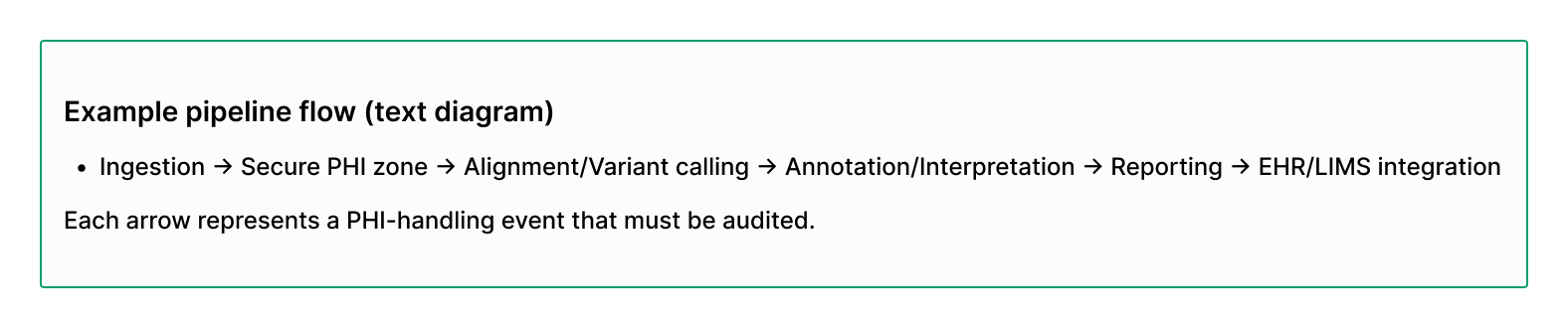
Pipeline orchestration (Airflow, Nextflow, Cromwell) is often a hidden compliance risk.
Checklist for HIPAA-aligned workflow systems
One of the most common HIPAA violations in genomics platforms is the leakage of PHI from logs.
Sensitive leakage sources
Best practices:
Required IAM principles for HIPAA-ready genomics platforms
Boundary controls
Clinical genomics pipelines require complete traceability.HIPAA doesn’t explicitly require lineage, but CLIA and CAP expectations make it essential.
What an adequate lineage system captures
A modern lineage system is typically stored as structured metadata in a non-PHI store, linked by a hashed identifier.
Interoperability adds both value and compliance burden.
Required safeguards when integrating with EHR systems
Required safeguards for LIMS connectivity
A minimal compliance checklist:
Access Controls
Audit Controls
Intergrity Controls
Transmission Controls
The required HIPAA SRA should:
Teams that skip SRA inevitably fail compliance audits.
Below is an objective comparison based on real-world platform builds.
Appr
oach
Pros
Cons
Build Inter
nally
Buy a Plat
form
Hybrid Model (Most common today)
This hybrid architecture is the dominant pattern because it balances speed, control, and compliance.
Access Controls
Audit Controls
Intergrity Controls
Transmission Controls
A genomics platform cannot rely solely on HIPAA for compliance; it must operate under a multi-regulatory umbrella.
A HIPAA-ready genomics platform includes:
For most mid-sized genomics organizations, the largest costs are security engineering + pipeline productionization, not sequencing compute.
Teams often see major ROI once pipeline failures decrease and clinical turnaround times shrink.
Compliance is a product capability.
NonStop has spent more than a decade building HIPAA-ready genomics platforms that combine secure cloud architecture, clinical-grade bioinformatics pipelines, and compliant EHR/LIMS integrations. Our engineering teams specialize in secure cloud architectures, PHI-aware data pipelines, and compliant workflow orchestration that meet the technical safeguards required for HIPAA, SOC 2, and CLIA. We help teams architect the full lifecycle of genomic data, ingestion, processing, interpretation, reporting, and EHR/LIMS integration using battle-tested patterns that eliminate common compliance failures such as uncontrolled PHI propagation, non-auditable pipelines, and weak IAM boundaries.
Because we sit at the intersection of bioinformatics, cloud infrastructure, and clinical interoperability, NonStop can identify gaps early, reduce rework, and deliver platforms that are not only compliant on paper but also reliable, scalable, and production-ready for high-throughput genomics and clinical use.HIPAA-readiness in genomics platforms is rarely about checking boxes. It's about designing platforms that embed data governance, security controls, pipeline reproducibility, and clinical interoperability from the start.
Teams who treat compliance as an engineering capability, not an afterthought, build platforms that scale faster, integrate more reliably, and earn trust across clinicians, labs, and partners.
If your team is exploring modernizing LIMS workflows, building cloud-native genomics tools, or integrating EHR/LIMS systems with AI and built-in compliance, NonStop is always open to a conversation. We've spent over a decade helping genomics and healthcare organizations design, engineer, and scale platforms that last.


