
The AI agent's decision in front of a genomics lab in 2026 is not really a technology decision. It is a cost decision with a number attached that most vendor pitches never mention: what a silent error costs once it reaches a patient report, versus what a few minutes of human review costs to catch it first.
That trade-off, not model quality, is what actually separates the AI capabilities running in production genomics labs today from the ones still stuck in pilot. Four narrow tasks have crossed into real, ongoing use with a measurable return. One broad category, full autonomous decision-making, has not, and the reason comes down to a cost the industry has already started pricing: courts have ruled that the company behind an agent, not the person who triggered it, carries accountability for what it does (SiliconANGLE, 2026).
Key Takeaways
- Hallucination rates in current LLM-based clinical systems run 8 to 15 percent, which is the actual cost basis for keeping a human reviewer at every checkpoint, not a hypothetical concern (MDPI, 2025)
- Narrow, well-reviewed AI use in a closely related field, radiology, has been tied to a 40 percent reduction in report creation time and a 25 percent gain in diagnostic consistency, the kind of return genomics labs can expect from the same narrow-scope pattern (MDPI, 2025)
- Four AI-assisted tasks are production-ready in clinical genomics labs today: variant classification support, requisition intake extraction, QC surfacing, and lab operations analytics
- CLIA requires a lab to independently verify AI performance against its own patient population, which means a vendor's benchmark is a cost item on your side, not proof you can skip the work (CAP, 2026)
- A fully autonomous agent that classifies or reports without human review fails the FDA's non-device clinical decision support test, which turns an efficiency play into a device-regulation problem (FDA guidance summary, 2026)
What Does It Actually Cost a Lab to Get an AI Agent Deployment Wrong?
Two documented failure modes explain most of the cost side of this equation. Premature handoff happens when an agent reaches a conclusion before gathering complete information. Silent hallucination happens when an agent gives a confident, wrong answer with nothing flagging that a person should check it. Researchers who built a framework specifically to catch both still needed deterministic guardrails on top of the model, not just better prompting, to keep failures from reaching a case file (arXiv, 2026).
Part of that cost sits underneath the model. Electronic records and interoperability standards were built for human review, not agent use, which forces an agent to reconstruct patient context through probabilistic inference instead of clean, structured data. That is where hallucination and broken auditability tend to start, and it is a structural problem, not a training one, which means better prompting will not fix it alone (arXiv, MedBeads, 2026).
The dollar cost is not abstract either. A misclassified suggestion that a trained analyst catches costs a few minutes. An autonomous agent that acts on the same misclassification without review can let the error travel into a report before anyone knows it exists, and from there, the cost is a corrective action plan, a CAP inspection finding, or worse. A clinical genomics lab has less tolerance for that outcome than almost any other AI use case, because what breaks downstream is a patient result.
What's the Actual Return on the AI Patterns That Are Production-Ready Right Now?
Four applications have moved past pilot, and each pays for itself in a specific, measurable way.
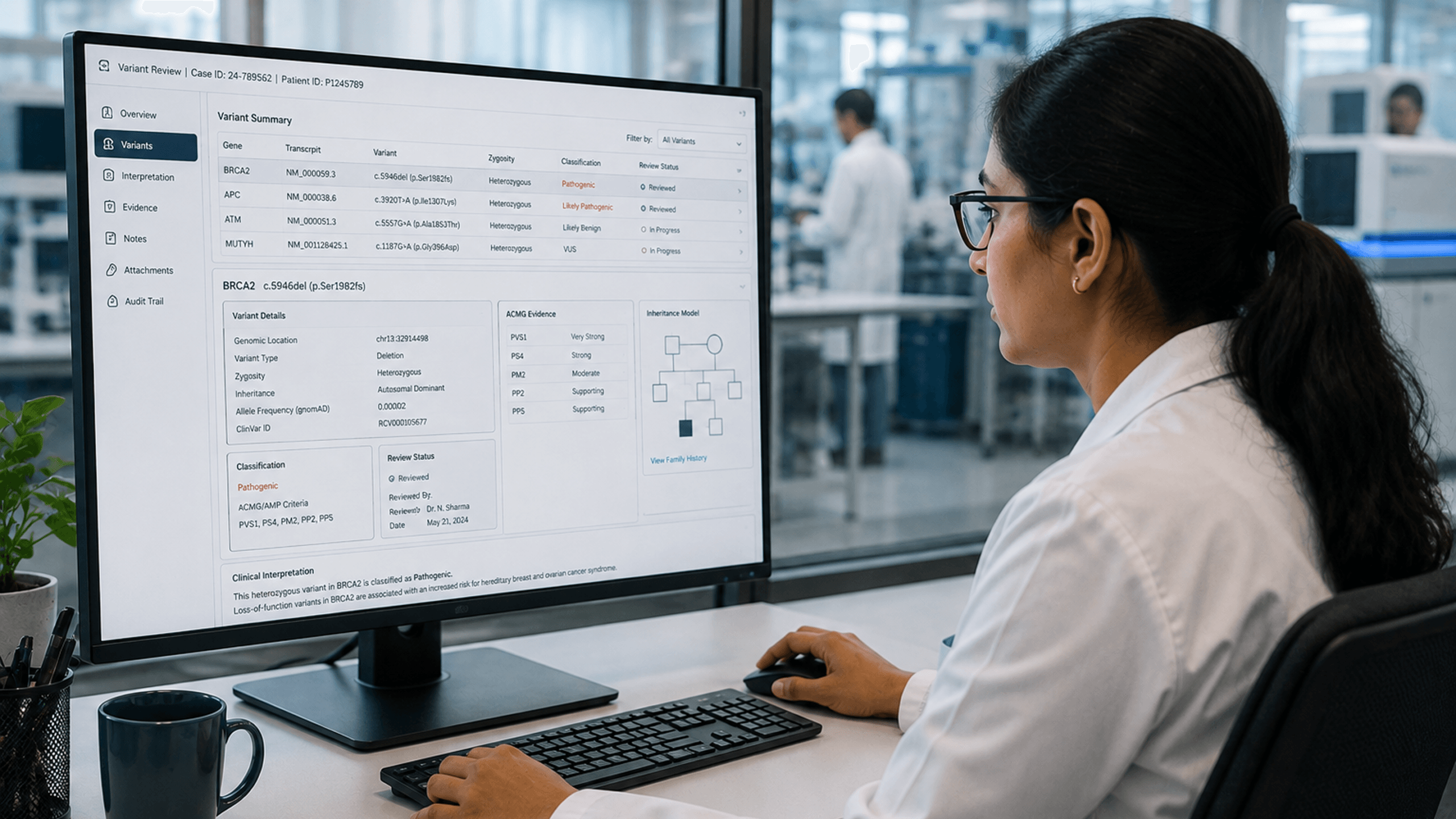
Variant Classification Support
Variant classification support aggregates population frequency data, functional predictions, and a lab's own prior classification history, then suggests an ACMG/AMP tier with a confidence score. An analyst reviews it, adjusts it if needed, and signs off, with every step logged. The return here is time, not headcount reduction: analysts spend less time assembling evidence and more time on judgment calls. Given that established, non-agentic classification tools already disagree with each other on real variants, the human sign-off step is also catching exactly the kind of discrepancy that would otherwise cost a lab a reclassification down the line (Bioinformatics, 2026).
Requisition Intake Extraction
Requisition intake extraction reads incoming forms, handwriting and checkboxes included, and pulls structured data out automatically. The return is fewer downstream data-entry errors, where a large share of avoidable rework actually originates.
QC Surfacing
QC surfacing ranks pipeline issues by severity, so a bioinformatician works the highest-risk flags first. The return is turnaround time on the cases that matter most, not turnaround time across the board.
Lab Operations Analytics
Lab operations analytics flags likely turnaround-time or capacity problems from historical patterns, and a lab operations lead decides what to do next. The return is fewer surprises in scheduling and staffing, caught early enough to act on.
NonStop has built and shipped this exact pattern across US genomics and precision medicine platforms. Varion applies classification support to variant interpretation and VUS prioritization, with analyst sign-off logged at every step. SmartReq applies the same logic to requisition intake. QC surfacing has shipped for bioinformatics teams reviewing MultiQC pipeline output, ranked by severity, without replacing the bioinformatician's judgment. All three run with full audit logging and, where a lab requires it, on-premise deployment. Labs that want a fast, no-pressure read on where a specific tool would land can run it past NonStop's team in a 15-minute scoping call.
Why Doesn't Full Autonomy Pay Off Yet, Financially or Regulatory?
The math changes once a system acts without review, and it changes for a regulatory reason as much as a technical one. The FDA's January 2026 clinical decision support guidance sets the actual line. Under the 21st Century Cures Act, software qualifies as lower-oversight, non-device CDS only if it meets four conditions, and the deciding one is whether a healthcare professional can independently review the recommendation's basis before acting on it.
Software that acts on its own, without that review, gets regulated as a full medical device instead, with a premarket review cost and timeline that most narrow AI tools were never built to absorb (FDA guidance summary, 2026).
CAP's public position adds weight to the same line. Its comments through late 2025 and into 2026 argue that AI systems should support, not replace, human diagnostic expertise, with pathologists and lab directors, not vendors, leading validation and ongoing monitoring of any AI tool used in their own lab (CAP, 2025).
CLIA then adds its own cost on top of whatever the FDA has reviewed: even after a lab reviews the FDA labeling for an AI-enabled test, CLIA requires the lab to independently demonstrate it can hit the same performance specifications with its own patient population before reporting results from it (CAP, 2026). A vendor's benchmark is a starting point for that work. It does not replace it, and it does not reduce the bill.
If your lab is deciding whether a proposed AI capability would actually clear that bar or hold up under a CLIA validation study, an AI Architecture Review from NonStop takes 45 minutes and gives you a clear, low-risk answer before a contract gets signed.
How Do You Calculate Whether a Vendor's AI Agent Claim Is Actually Worth Adopting?
Start with what happens when the system is wrong. A vendor with a tested, defined path for catching and correcting an error before it reaches a patient has priced that risk already. One whose pitch covers only speed and accuracy claims has not, and that gap becomes your lab's cost later.
Check whether a person reviews every case or only a sample. Those are different products with different risk profiles, and only the first satisfies CLIA's own verification standard, which means the second one still needs your lab to build the missing review layer itself.
Ask for evidence from a real clinical deployment, not a benchmark on a demo dataset. A benchmark shows what a system can do under ideal conditions. Your validation study, not the vendor's, is what determines the actual return.
Frequently Asked Questions
Can AI fully replace variant classification in a genomics lab?
No, not under current FDA and CLIA rules. AI can aggregate evidence and suggest a tier with a confidence score, but a qualified analyst still reviews and signs off before it reaches a report.
Are AI agents FDA-approved for genomic diagnostics?
Individual AI-enabled tools can be FDA-cleared or qualify under the FDA's non-device clinical decision support category. A fully autonomous agent that acts without human review does not currently fit either path (FDA guidance summary, 2026).
What happens when an AI agent hallucinates in a lab report?
If a person reviews every output, a hallucinated suggestion gets caught before it reaches the patient's record. If an agent acts without review, a hallucinated conclusion can move downstream silently, which is the exact failure mode researchers call silent hallucination (arXiv, 2026).
Is it worth waiting for fully autonomous AI before adopting any of this?
No. The four production-ready categories already return measurable time and accuracy gains today. Waiting means giving up a return that is already available and already defensible under current regulation.
What's the fastest way to find out if a specific AI vendor claim holds up?
Run the claim past a technical review before a contract gets signed rather than after. That is the difference between catching a cost problem early and discovering it during a CAP inspection.
The labs getting the strongest return from AI in 2026 are not chasing full autonomy. They are running these four tasks well, with a qualified person at the decision point on every case and a complete audit trail behind it.
Measure AI Investment Risk Before Committing Budget
If your lab is weighing a specific AI agent investment, an AI Architecture Review from NonStop takes 45 minutes and gives you a clear, low-risk read on what would actually hold up before you commit budget to it.

Mahendra works as a Sr. Bioinformatics Engineer at NonStop. He builds genomic pipelines, agentic AI systems, and AI-powered products for genomics and life sciences. He has 10+ years of experience in bioinformatics and genomics software. He studied Biotechnology at Mumbai University.