

Frustration of Manual Interpretation
Recently, a client reached out to us with a familiar frustration. Their team was spending hours reviewing MultiQC reports across large sequencing batches, scanning the same sections repeatedly to extract the same set of metrics.
The bioinformatician was not struggling with interpretation. They knew exactly what they were looking for. The problem was repetition. Every report required manually locating per-base quality trends, duplication rates, adapter content, GC bias, and coverage summaries before deciding whether a sample could move forward.
One evening, that frustration escalated. Their sequencing core delivered 48 exome runs at once. The workflow was routine: FASTQ files went through FastQC, and MultiQC aggregated the results into a consolidated report.
However, consolidation did not equal clarity. The bioinformatics lead still had to review dense plots and tables for each batch, validate thresholds, check context, and mentally separate noise from meaningful signals.
Community discussions often mention how exhausting this process can become, even for experienced analysts. That evening proved the point.
What the client needed was not another quality-control tool. They needed a way to extract exactly the information they cared about, consistently, without manually searching through every plot.
If a system could summarize the report and surface only what mattered, the work would become faster and more focused. Bioinformaticians could spend less time confirming pass-or-fail outcomes and more time on actual science, troubleshooting edge cases, and improving pipelines.
That request became the starting point for building an AI-assisted quality-control reporting layer on top of existing MultiQC tools.
AI Is Assistance, Not Replacement
When introducing AI into clinical or research pipelines, the first concern is whether machines are intended to replace human expertise. The answer here is no.
The system we built prepares an executive summary and a ranked list of quality-control findings so analysts can focus on what matters.
It surfaces the information a bioinformatician typically looks for and provides actionable insights based on that information. However, it never edits the underlying data or makes the final decision.
The bioinformatician remains in control. The AI acts as a knowledgeable assistant, not a replacement.
Technical Architecture of the Pipeline
We developed the AI-assisted quality-control pipeline using Nextflow.
We chose Nextflow because it provides scalable, reproducible, and portable workflows. It simplifies the process of combining different tools and encapsulates dependencies in containers so that the same pipeline can run consistently across environments.
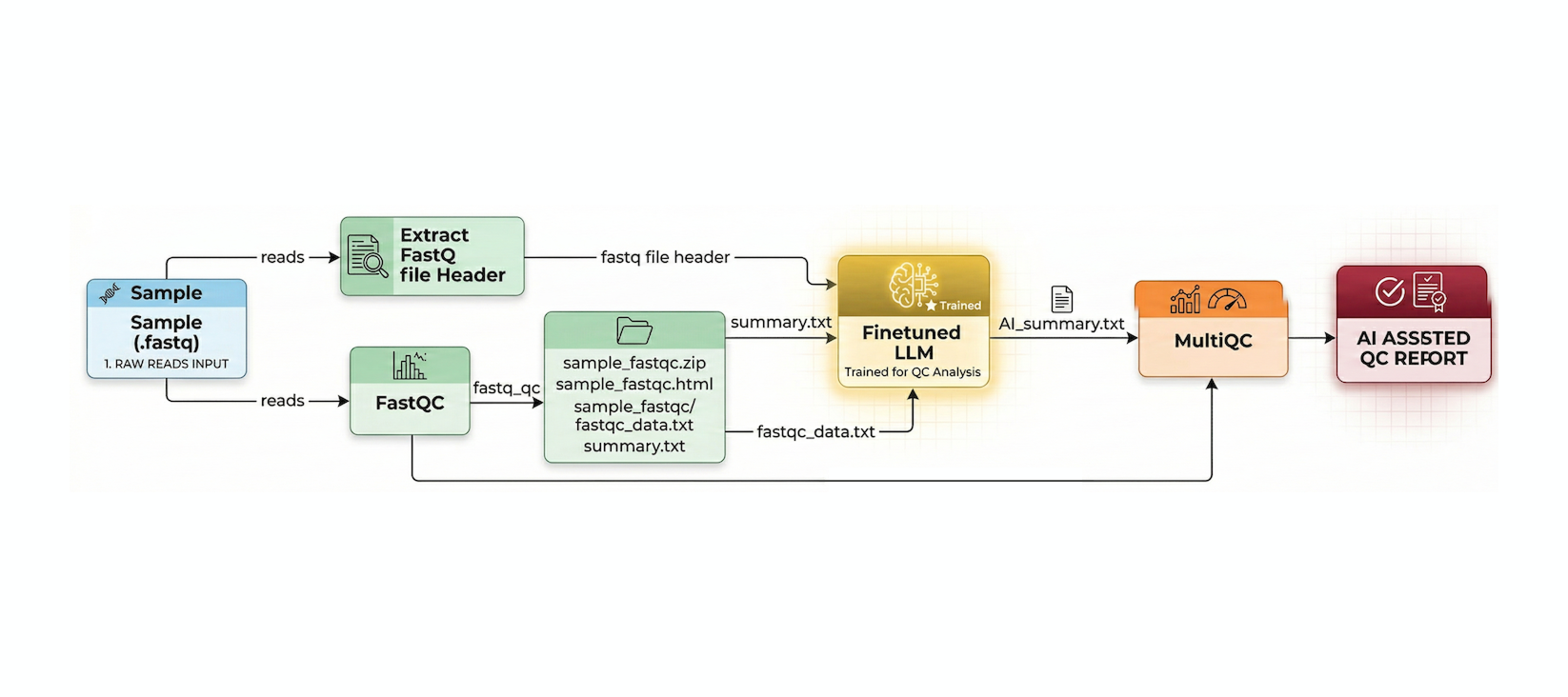
AI-Assisted MultiQC Report Analysis
The pipeline performs the following steps:
- Extracts the header information to capture instrument and sequencing-run details.
- Runs quality checks on each sample.
- Aggregates quality-control outputs into a single HTML report.
- Collects the relevant quality-control metrics and constructs a prompt for the language model.
- Uses the prompt to generate an executive summary with ranked issues and recommendations.
- Inserts the AI-generated summary at the beginning of the MultiQC report.
Nextflow provided a portable and reproducible workflow, while the modular architecture allows individual components to be replaced or the entire pipeline to be deployed in different environments with minimal effort.
Future Scope
This proof of concept demonstrates that AI can meaningfully assist quality-control reporting. Several extensions could further improve its utility.
Track Trends
Collect AI-generated summaries across sequencing runs to identify instrument drift, recurring quality issues, or batch effects over time.
Model Fine-Tuning
Train the AI using historical quality-control decisions so that it can better adapt to the laboratory's data, thresholds, and review practices while reducing mistakes.
Structured Outputs
Return structured JSON containing fields such as module, severity, evidence, and suggested command to make downstream automation easier.
Confidence Scores
Attach a confidence level to every recommendation so analysts can quickly identify findings that require additional manual verification.
LIMS Integration
Send quality-control summaries directly into the laboratory information management system to update sample records, record review decisions, and support downstream workflows.
Clinical Compliance
Validate the pipeline, record all prompts and responses, and document model, workflow, and configuration changes to support regulatory requirements.
An Intelligent Layer of Triage
Manual quality control of next-generation sequencing data becomes increasingly demanding as sample volumes grow.
Even with consolidated reports, experts must still interpret dozens of metrics, validate thresholds, and confirm whether each sample is suitable for downstream analysis. That repetition introduces fatigue and increases the risk of oversight.
The AI-assisted pipeline described here builds on existing quality-control workflows and adds an intelligent layer of triage.
It highlights important findings, ranks potential issues, and provides actionable guidance while keeping final authority with the bioinformatician.
Built with Nextflow for scalability, reproducibility, portability, and modularity, the system can be integrated into existing laboratory and bioinformatics environments.
For laboratories facing similar quality-control bottlenecks, this approach offers a plug-and-play improvement to the current workflow rather than a disruptive replacement.

Mahendra works as a Sr. Bioinformatics Engineer at NonStop. He builds genomic pipelines, agentic AI systems, and AI-powered products for genomics and life sciences. He has 10+ years of experience in bioinformatics and genomics software. He studied Biotechnology at Mumbai University.