


HIPAA-Ready Genomics Platforms: Key Development Gaps and How to Fix Them
Over the last decade, genomics has moved from research-only environments into clinical workflows, while the digital infrastructure supporting that shift has struggled to keep pace.
The NIH has repeatedly highlighted the rapid growth of sequencing output, and the U.S. Office of the National Coordinator for Health IT continues to emphasize that genomic results must be handled with the same rigor as other HIPAA-regulated clinical data.
The CDC also notes that genomic data carries unique privacy risks because of its inherent identifiability.
Most teams underestimate what it truly means to build a HIPAA-ready genomics platform.
Teams often underestimate the architectural implications, data-layer controls, cross-system dependencies, cloud-security posture, and operational safeguards required to maintain compliance as pipelines scale.
This guide is designed for directors and vice presidents of genomics, bioinformatics leads, LIMS managers, CTOs, CIOs, digital-health founders, and precision-medicine teams evaluating vendors, choosing internal architectures, or planning modernization.
Why HIPAA for Genomics Is More Complex Than Most Teams Expect
Genomic data is fundamentally different from standard clinical attributes. DNA data is intrinsically identifiable, and even pseudonymized VCF files may be reidentified when cross-referenced with public genomic datasets.
Common factors that increase security scope include:
- Whole-genome or whole-exome sequencing output
- Long-term archival of FASTQ and CRAM files
- AI and machine-learning models trained on combined genomic and clinical datasets
- Cross-entity data exchange between LIMS, EHR, CRO, cloud, and on-premises systems
- Automated variant-interpretation pipelines
- Patient-facing genomics reports and portals
HIPAA compliance in this context directly affects architecture, workflows, data lifecycles, and operational controls.
Why Genomics Teams Discover Compliance Risk Too Late
1. Research-First Engineering Culture
Bioinformatics teams often prototype pipelines in flexible research environments and attempt to productionize them later.
- No structured audit trail for pipeline steps
- Manual data movement
- Containers built without controlled dependency management
- No clear separation between development, bioinformatics, and operations roles
- No PHI-safe logging or redaction process
2. Underestimating HIPAA Technical Safeguards
A cloud platform being HIPAA-eligible does not make the implementation automatically compliant.
- Cross-account IAM strategy
- Secure PHI-processing zones
- Encryption-key segregation
- Minimum-necessary data exposure within pipelines
- Logs that capture sample identifiers or metadata
- PHI inside workflow-orchestration systems
3. EHR Interoperability Expands the Attack Surface
HL7, FHIR, genomics ordering, and clinical decision-support integrations introduce stricter authentication, auditability, breach-reporting, and PHI-flow requirements.
What Mature HIPAA-Aligned Genomics Platforms Look Like
Data Handling
- Tiered storage with retention policies
- Automated deletion and archival workflows
- Versioned and immutable pipeline outputs
- PHI-free analytical datasets for research and development
Access Control
- Fine-grained role-based access by job function
- Separate developer and non-developer access to production data
- Controlled bastion-host and jump-box policies
- No personal access keys in CI/CD workflows
Cloud Security
- Private VPC architecture with restricted egress
- Boundary-limited subnets for PHI processing
- Controlled metadata endpoints
- Customer-managed encryption keys
Pipeline Orchestration
- Fully auditable workflow execution
- Reproducible container builds
- Metadata tracking at each pipeline stage
- PHI-free logs
Operational Maturity
- Documented incident-response playbooks
- Quarterly access reviews
- Monitoring for anomalous data movement
- Vendor-risk management
Step-by-Step Implementation Guide: Building a HIPAA-Ready Genomics Platform
1. Define the Data Classification Model
| Data Type | Classification | Implementation Impact |
|---|---|---|
| Patient demographics | PHI | Clearly within HIPAA scope. |
| FASTQ, BAM, and CRAM | PHI and intrinsically identifiable | Cannot be treated as anonymous data. |
| VCF with clinical metadata | PHI | May include unique identifiers and clinical context. |
| Aggregated statistics | Potentially non-PHI | Only when properly de-identified. |
| Pipeline logs | Potential PHI | Requires redaction. |
| System metadata | Non-PHI | Safe only when not linked to individuals. |
2. Architect the PHI Processing Zone
- Keep PHI inside secure subnets.
- Separate metadata from PHI where possible.
- Use customer-controlled encryption keys.
- Sanitize logs before centralized storage.
- Use hardened, immutable pipeline containers.
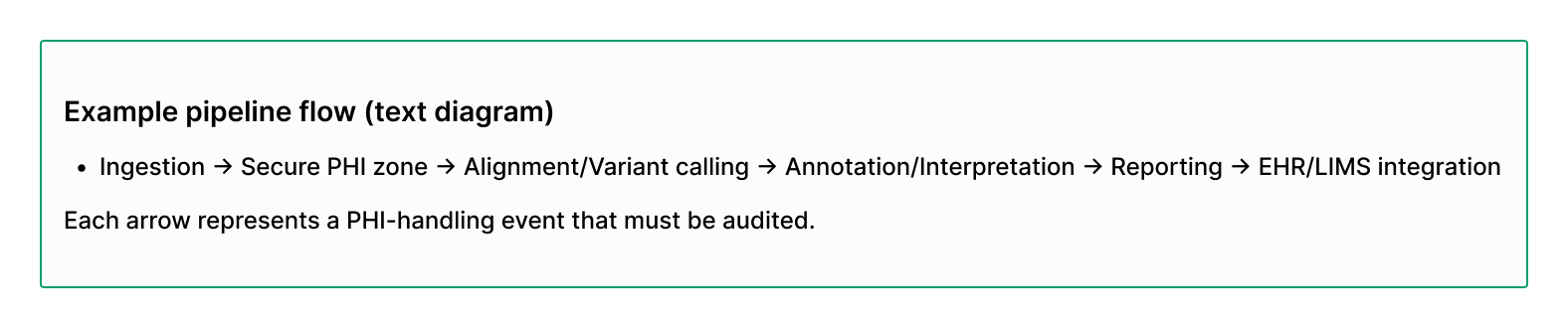
3. Secure the Genome-Processing Pipeline End to End
- No PHI in environment variables, task names, or step identifiers
- Log-redaction middleware
- Versioned pipelines and reproducible containers
- Encryption in transit and at rest
- Short-lived cloud credentials
- Separate storage for raw and interpreted genomic data
4. Implement PHI-Aware Logging and Observability
- Scrub sample IDs, FASTQ filenames, variant identifiers, and EHR order IDs.
- Maintain known-sensitive-token lists.
- Enforce a no-PHI logging policy.
- Run centralized logs through DLP scanning.
5. Establish IAM and Boundary Controls
- Least-privilege access by workflow, pipeline, and role
- Combined RBAC and attribute-based controls
- No persistent credentials
- Just-in-time elevated access
- Federated SSO through SAML or OIDC
- Restricted egress and VPC endpoints for storage
6. Build a Fully Auditable Data-Lineage System
- Source FASTQ checksum
- Alignment and variant-calling software versions
- Reference-genome version
- Filter parameters
- Interpretation-model version
- Timestamped operator actions
- EHR order linkage
7. Prepare for EHR and LIMS Interoperability
- FHIR server with strong authentication
- Audit trails for every FHIR read and write
- Controlled vocabularies such as LOINC, HGVS, and ClinVar
- Queue-based messaging
- API gateway with request-level authorization
- Versioned schema contracts and PHI-free errors
8. Validate Against HIPAA Technical Safeguards
- Unique user IDs and session expiration
- Role-based access and emergency-access procedures
- Immutable centralized audit logs
- Checksums and reproducible pipelines
- TLS 1.2 or newer and mutual TLS for service communication
9. Conduct a HIPAA Security Risk Assessment
- Map all data flows.
- Identify every PHI touchpoint.
- Evaluate controls against threats.
- Document mitigation strategies.
- Map storage, compute, and orchestration components to risk.
Build vs. Buy: What Is Practical for Genomics Teams?
| Approach | Advantages | Limitations |
|---|---|---|
| Build internally |
|
|
| Buy a platform |
|
|
| Hybrid model |
| Requires careful integration and governance. |
Cost and ROI
Initial Investment
- Cloud-environment configuration
- Secure pipeline orchestration
- EHR and FHIR gateway
- Audit-log infrastructure
- IAM and RBAC design
- Compliance architecture review
Ongoing Operating Costs
- Security patching
- Business continuity
- Penetration testing
- Access reviews
- Container maintenance
- Observability infrastructure
ROI Sources
- Faster assay onboarding
- Lower compliance-risk overhead
- Faster clinical-partner integration
- More efficient computing
- Reduced quality-control overhead
- Higher throughput through automated reporting
Common Mistakes in HIPAA-Focused Genomics Builds
- Putting PHI in SQS or Kafka messages instead of passing references
- Using the same storage location for raw and processed genomic data
- Logging sample identifiers in workflow orchestrators
- Giving developers direct access to the production VPC
- Failing to automate deletion and retention
- Using pipelines that are not version-pinned
- Treating compliance as a security project rather than a product requirement
Best Practices for HIPAA-Ready Genomics Development
- Isolate PHI-heavy workloads in dedicated zones.
- Use infrastructure as code and short-lived credentials.
- Use immutable containers and automated quality gates.
- Classify data and apply tiered retention rules.
- Run incident-response exercises and continuous compliance monitoring.
- Coordinate bioinformatics, security, software, and operations teams.
Why Leading Genomics Teams Work With NonStop
NonStop has spent more than a decade building HIPAA-ready genomics platforms that combine secure cloud architecture, clinical-grade bioinformatics pipelines, and compliant EHR and LIMS integrations.
The team works across bioinformatics, cloud infrastructure, and clinical interoperability to identify architectural gaps early and reduce costly rework.
HIPAA readiness is not about checking boxes. It is about embedding governance, security controls, reproducibility, and interoperability into the platform from the beginning.
If your organization is modernizing LIMS workflows, building cloud-native genomics tools, or integrating EHR and LIMS systems with AI and compliance, NonStop is ready to begin the conversation.
